

What You'll Learn:
- The key differences between CCPA and CPRA and why they matter for ad monetization.
- How to determine if these laws apply to your publishing business.
- A 7-step compliance checklist you can start implementing today.
- How to handle "Do Not Sell or Share" and "Limit Use of Sensitive Personal Information" requests.
- The role of Consent Management Platforms (CMPs) and the Global Privacy Control (GPC) signal.
The technical complexity of privacy compliance can be daunting, but the right tools can automate the process. A robust Consent Management Platform (CMP) is designed to simplify CPRA for publishers, ensuring you stay compliant without sacrificing revenue.
---
The Basics: From CCPA to CPRA - What Changed?
To understand your obligations, you first need to understand the evolution of the law. Think of it less as two separate laws and more as version 1.0 and version 2.0.
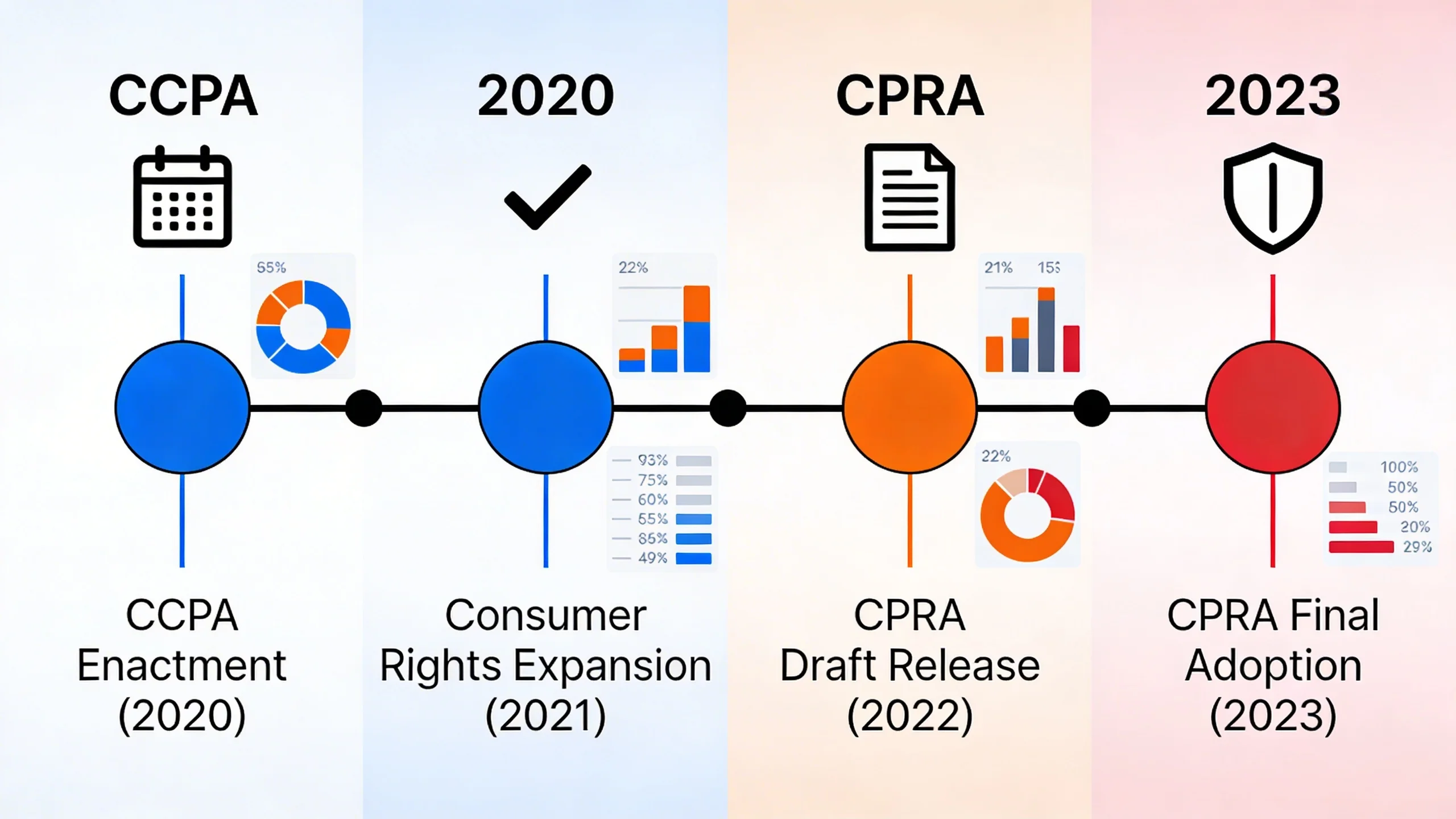
The California Consumer Privacy Act (CCPA) went into effect in 2020. It was a foundational law that gave California consumers landmark rights over their personal data, including the right to know what data businesses collect about them and the right to opt out of the "sale" of that data.
The California Privacy Rights Act (CPRA), which was passed in 2020 and became fully enforceable on July 1, 2023, is best understood as "CCPA 2.0." It doesn't replace the CCPA; it significantly amends and expands it, closing loopholes and introducing new consumer rights and business obligations.
For publishers, the most critical evolution was the shift from just "selling" data to also include "sharing" data. CPRA explicitly defines "sharing" as disclosing a consumer's personal information to a third party for cross-context behavioral advertising, whether or not money is exchanged. This definition directly targets the very foundation of programmatic advertising, making compliance an absolute necessity for monetized websites.
This table breaks down the key differences between CCPA and CPRA and their impact on your operations.
| Feature | CCPA (California Consumer Privacy Act) | CPRA (California Privacy Rights Act) | Why It Matters to Publishers |
|---|---|---|---|
| Scope | "Selling" personal information. | "Selling" and "Sharing" personal information. | "Sharing" directly targets programmatic advertising, ad exchanges, and retargeting. |
| Consumer Rights | Right to Know, Delete, Opt-Out of Sale. | Adds Right to Correct, Right to Limit Use of Sensitive Personal Information (SPI). | New user request workflows and website links are needed to handle these new rights. |
| Sensitive Data | No specific category. | Creates a new category: Sensitive Personal Information (SPI) (e.g., precise geolocation, health data, racial origin). | Publishers collecting geolocation data via apps or bid requests must provide a new, specific opt-out. |
| Enforcement | California Attorney General. | AG + the new California Privacy Protection Agency (CPPA). | A dedicated agency with more resources means a higher risk of audits and fines. |
---
Does CPRA Apply to My Publishing Business? The Compliance Thresholds
This is the first question every publisher asks. The answer is not based on where your business is located, but on the scope of your operations and your audience.
Your publishing business must comply with CPRA if you do business in California (meaning, you have visitors from California) AND you meet at least one of the following three thresholds:
- Revenue Threshold: You have a gross annual revenue of over $25 million. (Note: This is your total company revenue, not just revenue generated from California).
- Data Processing Threshold: You annually buy, sell, or share the personal information of 100,000 or more California consumers or households.
- Revenue from Data Threshold: You derive 50% or more of your annual revenue from selling or sharing California consumers' personal information.
For most digital publishers, the second threshold is the most common trigger. A "consumer" can be a unique visitor, and "personal information" includes cookies, device IDs, and IP addresses. If your site receives around 8,000-9,000 unique visitors from California per month, you will likely meet the 100,000 annual threshold.
Actionable Advice: If you use programmatic advertising and have significant US traffic, you should operate under the assumption that you meet the 100,000-consumer threshold. It's far safer to comply than to risk an audit and potential violation.
---
The Publisher's 7-Step CPRA Compliance Checklist
Feeling overwhelmed? Don't be. We've broken down the path to CPRA compliance for publishers into seven clear, manageable steps.
1. Conduct a Comprehensive Data Audit
You cannot protect what you don't know you have. The first and most critical step is to map your data flows. This audit is the foundation of your entire privacy program. You need to document:
- What data you collect: Go beyond the obvious. List everything, including IP addresses, device IDs, cookies, mobile advertising IDs (MAIDs), email addresses from newsletters, precise geolocation data, and any user-provided information in comments or forums.
- Where you collect it: Pinpoint every touchpoint. This includes your website analytics (like Google Analytics 4), ad server, header bidding wrappers and partners, Supply-Side Platforms (SSPs), Data Management Platforms (DMPs), and your email service provider.
- Why you collect it: Define the business purpose for each data point. Is it for website analytics, targeted advertising, content personalization, or email marketing? This is required for your privacy policy.
- Who you share it with: This is the most crucial part for CPRA. Create a detailed list of all third parties that receive user data, including ad exchanges, SSPs, identity partners, and other ad tech vendors in your supply chain.
2. Update Your Privacy Policy
Your privacy policy is a legally binding document. Under CPRA, it needs to be a comprehensive and transparent resource for your users. It's no longer a "set it and forget it" page. You must review and update it to include:
- A clear description of all consumer rights under CPRA (Right to Know, Delete, Correct, Opt-Out, and Limit).
- The categories of personal information and sensitive personal information you collect, along with the specific business purpose for collecting each category.
- The categories of all third parties with whom you sell or share personal data.
- Your data retention policies, explaining how long you store each category of personal information.
- Clear, accessible instructions on how users can exercise their rights, including links to your opt-out pages and a contact method for submitting requests.
3. Implement Clear "Do Not Sell or Share My Personal Information" Mechanisms
CPRA requires you to provide consumers with an easy way to opt out of the sale or sharing of their data. This isn't just a suggestion; it's a mandate.
You must place a conspicuous link, typically in your website's footer, with the text "Do Not Sell or Share My Personal Information."
This link must lead to a dedicated page where users can easily submit their opt-out request. But the work doesn't stop there. The most important part is the technical implementation: when a user clicks this link and opts out, that preference signal must be captured and passed downstream to all of your ad tech partners to stop them from using that user's data for cross-context behavioral advertising. This is where a Consent Management Platform (CMP) becomes essential, as it automates this complex signaling process.
4. Add the "Limit the Use of My Sensitive Personal Information" Link
CPRA created a new category of data called Sensitive Personal Information (SPI), which includes precise geolocation, racial or ethnic origin, religious beliefs, and health information.
If you collect any SPI—for example, if you're a weather publisher using precise geolocation to serve localized ads—you must provide a separate link titled "Limit the Use of My Sensitive Personal Information." This gives users the right to restrict the use of their SPI to only what is strictly necessary to provide the service they requested (e.g., showing the local weather, but not using that location for ad targeting).
Alternatively, CPRA allows you to combine both links into a single, unified link, such as "Your Privacy Choices," which leads to a page where users can manage all their privacy preferences at once.
5. Honor the Global Privacy Control (GPC) Signal
The Global Privacy Control (GPC) is a game-changer for user privacy and a mandatory requirement for publishers.
What it is: GPC is a signal sent from a user's browser or browser extension that automatically communicates their preference to opt out of all data selling and sharing. It's a universal "no" that applies to every website the user visits.
Why it's mandatory: CPRA regulations are explicit: businesses must treat a valid GPC signal as a formal, legally binding request to opt out. You cannot ignore it.
How to implement it: Detecting the GPC signal and ensuring it's honored across your entire ad stack is a significant technical challenge. This is arguably the strongest argument for using a professional-grade CMP. A robust CMP is designed to automatically detect the GPC signal on a visitor's browser and immediately block data sharing with your ad tech vendors for that user, ensuring frictionless compliance.
6. Review and Update All Vendor Contracts
As a publisher, you don't operate in a vacuum. You rely on a complex ecosystem of ad tech vendors. Under CPRA, you are responsible for what they do with your users' data.
This means you must review your contracts with every partner who processes personal information on your behalf. Ensure you have a Data Processing Addendum (DPA) in place with each one. This DPA is not just a formality; it must include CPRA-specific clauses that legally bind the vendor to:
- Use the data only for the specific purposes you've outlined.
- Assist you in responding to user rights requests (e.g., deleting a user's data from their systems upon your request).
- Adhere to the same data protection standards required by CPRA.
7. Establish a Process for Handling User Rights Requests
When a California resident submits a request to Know, Delete, or Correct their information, you have a 45-day window to respond. You need a reliable internal process to handle these requests efficiently and document your actions.
Your process should include:
- A designated intake method: Use a specific email address (e.g.,
privacy@yourdomain.com) and/or a web form on your site to receive requests. - A verification workflow: You must take reasonable steps to verify the identity of the person making the request to prevent fraud.
- An execution plan: Have a clear internal procedure for who receives the request, how to find the user's data across your systems (analytics, email lists, etc.), and how to execute the deletion or correction.
- A documentation trail: Keep a record of all requests received and the actions taken to fulfill them.
---
Beyond the Checklist: Turning Compliance into a Competitive Advantage
Meeting CPRA requirements can feel like a defensive, cost-intensive chore. But savvy publishers are reframing compliance as a strategic opportunity.
- Build User Trust: In an era of data breaches and privacy scandals, transparency is a powerful brand differentiator. A clear, easy-to-navigate privacy experience shows users you respect them. A user who trusts you is more likely to return, subscribe to your newsletter, and engage with your content.
- Prepare for the Future: CPRA is not the end of US privacy legislation; it's the beginning. States like Virginia (VCDPA), Colorado (CPA), Utah (UCPA), and Connecticut (CTDPA) already have their own comprehensive laws. Building a strong privacy foundation for CPRA makes it exponentially easier to adapt as this legal patchwork grows.
- Accelerate Your First-Party Data Strategy: As regulations and browser changes (like the deprecation of third-party cookies) make third-party data less reliable, the value of your first-party data skyrockets. Privacy compliance is the perfect catalyst for this shift. By offering a trustworthy experience, you encourage users to voluntarily share their data through newsletter sign-ups, site registrations, and surveys, building a valuable, sustainable asset for the future.
---
Conclusion: Your Path to CPRA Compliance Starts Now
CPRA is here to stay. It directly impacts ad monetization through its broad definition of "sharing," and compliance is mandatory, not optional. The potential fines and, more importantly, the loss of user trust are risks no publisher can afford to take.
By breaking the process down, the path forward becomes clear. A thorough data audit, a transparent and updated privacy policy, and robust, user-facing controls are the cornerstones of compliance. While the checklist may seem long, the technical complexities of honoring GPC signals and passing opt-out preferences to hundreds of ad partners can be automated.
The technical complexity of honoring GPC signals and passing opt-outs to hundreds of ad partners can be overwhelming. A Consent Management Platform automates this process, ensuring you stay compliant without sacrificing revenue. See how IMC's consent management solution simplifies CPRA for publishers.
---
Frequently Asked Questions (FAQ)
Q1: I'm not based in California. Do I still need to comply with CPRA?
A: Yes, if you meet any of the compliance thresholds and have website visitors from California, the law applies to you. CPRA is based on where the consumer resides, not where your business is located.
Q2: What is the penalty for not complying with CPRA?
A: The California Privacy Protection Agency (CPPA) can issue fines of up to $2,500 per violation, or $7,500 per intentional violation (or for any violation involving minors). For a website with significant traffic, these fines can add up very quickly.
Q3: Does CPRA mean I can't do targeted advertising anymore?
A: No. It means you must give California consumers a clear and easy choice to opt out of the "sharing" of their data for cross-context behavioral advertising. If a user does not opt out, or if they opt in, you can continue to serve them targeted ads.
Q4: Is a cookie banner enough for CPRA compliance?
A: Not by itself. A simple "we use cookies" banner that doesn't offer a real choice is insufficient. For CPRA, you must provide the specific opt-out links ("Do Not Sell or Share"), honor Global Privacy Control (GPC) signals automatically, and manage user rights requests. A full-featured Consent Management Platform (CMP) is the recommended solution to handle these complex requirements.