
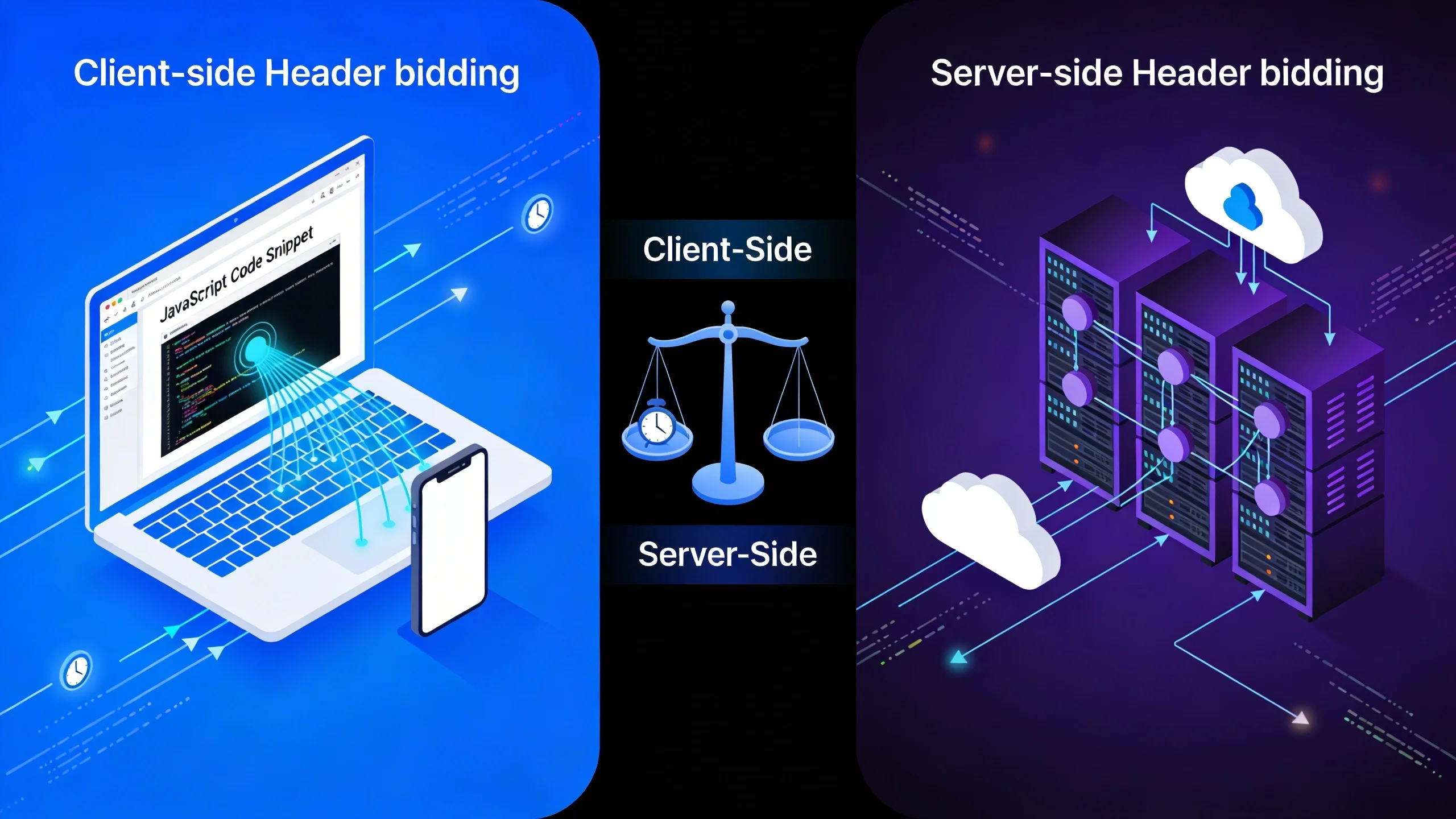
A Quick Refresher: What is Header Bidding?
Before we pit client-side against server-side, let's quickly revisit why header bidding exists. For years, the programmatic world was dominated by the "waterfall" method. In this system, ad inventory was offered to demand partners sequentially, one by one, based on historical price averages. If the first partner didn't bid high enough, the inventory was passed down to the next, and so on. This process was inefficient and often meant publishers sold their valuable ad space for less than it was worth, as the highest bidder might have been fourth or fifth in line and never even got a chance to bid.
Header bidding shattered this inefficient model. It’s an advanced programmatic technique where publishers offer ad inventory to multiple ad exchanges simultaneously before making a single call to their ad server.
The core benefit is simple but powerful: creating a unified, real-time auction with maximum competition. Think of it this way: the waterfall was like asking potential home buyers for their offer one by one. Header bidding is like inviting every potential buyer to a single, lightning-fast auction at once. The result is inevitably a higher price, leading to increased CPMs and significantly more revenue for the publisher.
Deep Dive: Client-Side Header Bidding (The Original)
Client-side header bidding is the foundational method that brought this technology to the mainstream. It’s often synonymous with Prebid.js, the most popular open-source wrapper solution. In this model, the user’s browser is the auction house, doing all the heavy lifting.
How It Works: The Browser Does the Heavy Lifting
The process is managed by a piece of JavaScript code placed in the <head> section of your website's HTML—hence the name "header" bidding.
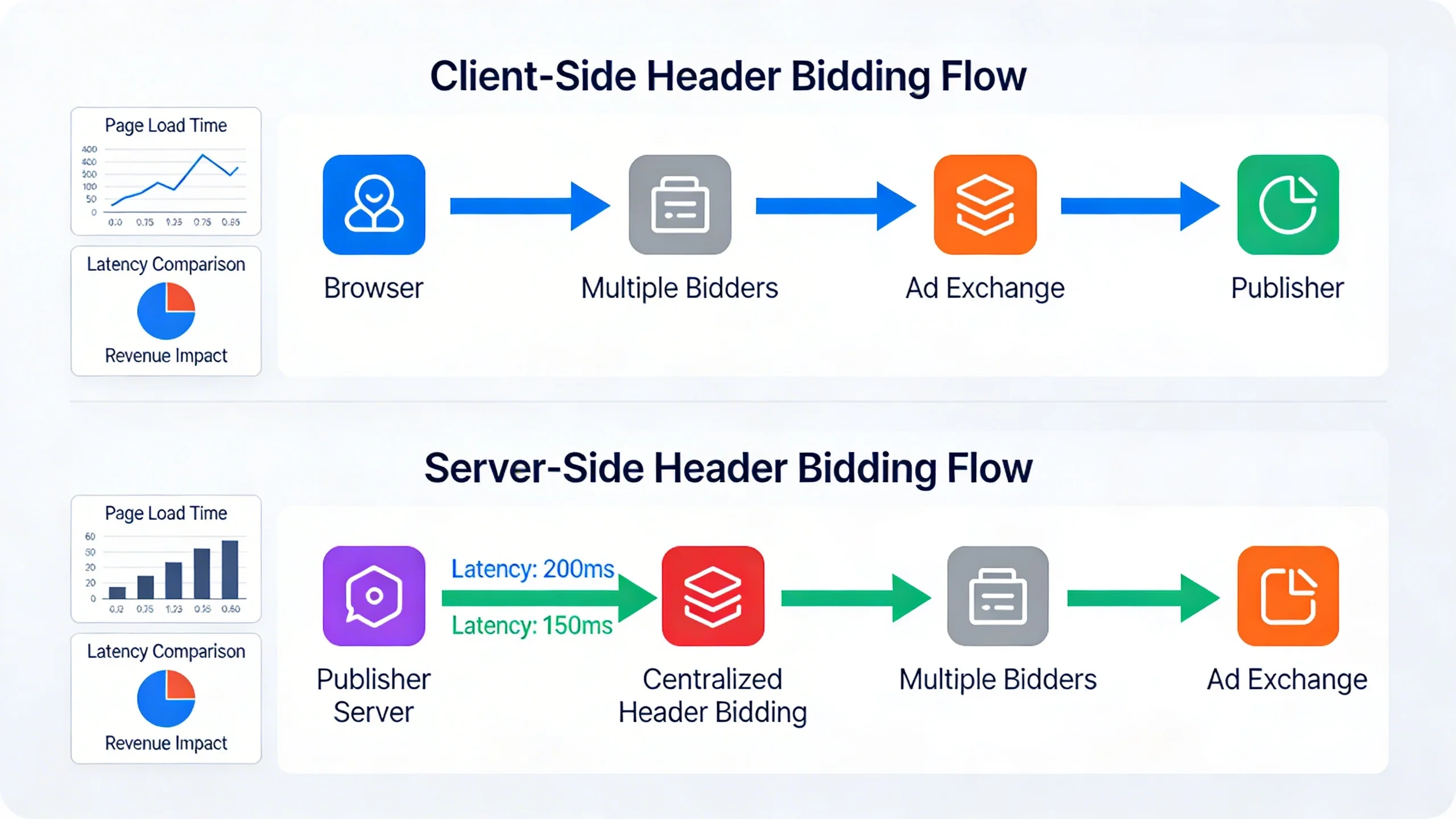
- Initiation: When a user visits your page, a JavaScript tag (the "wrapper") in the site's header loads.
- Bid Requests: This wrapper code then makes simultaneous ad calls directly from the user's browser to multiple demand partners (SSPs, Ad Exchanges).
- Bid Collection: Each partner responds with a bid for the ad impression. These bids are collected and evaluated within the browser.
- Winning Bid to Ad Server: The wrapper identifies the highest bid and passes it, along with targeting keywords, to your ad server (e.g., Google Ad Manager). The ad server then compares this bid against any others it has (like direct-sold campaigns or AdX) and serves the winning creative.
[Insert a simple diagram/flowchart here showing multiple arrows leaving the User Browser and going to various Demand Partners, then one arrow returning to the Ad Server.]
The Pros of Client-Side Header Bidding
- Maximum Transparency: Because the entire auction happens within the user's browser, publishers have direct, granular insight into the process. You can see every bid request, every response, and every timeout. This visibility is crucial for troubleshooting and understanding partner performance.
- Better Cookie Syncing: This is arguably the biggest advantage. The auction has direct access to third-party cookies stored in the user's browser. This allows for seamless user ID matching between the publisher, the SSPs, and the advertisers' DMPs. A higher match rate means advertisers can better identify and value the user, leading to more targeted, higher-value bids and ultimately, higher CPMs.
- Simpler Setup (Relatively): For publishers just starting out or those with a manageable number of demand partners, client-side is often easier to implement. The open-source community around Prebid.js provides extensive documentation, support, and pre-built adapters for hundreds of partners, lowering the initial barrier to entry.
The Cons of Client-Side Header Bidding
- The Latency Problem: This is the primary drawback and the reason server-side was invented. Each demand partner you add creates another HTTP request that the browser must manage. While each call adds only a small delay, the cumulative effect of 5, 7, or 10 partners can significantly slow down page load times. This hurts the user experience, increases bounce rates, and can negatively impact your Core Web Vitals and SEO rankings.
- Browser Limitations: Every web browser has a limit on the number of simultaneous connections it can make to a single domain. This creates a practical cap on how many demand partners you can effectively run client-side before performance degrades sharply. Most experts recommend staying under 7-8 partners.
- Operational Overhead: Managing the configurations, code, and timeout settings for a growing list of partners directly in your site's header can become complex and unwieldy. It requires diligent monitoring and technical resources to keep everything running smoothly.
The Evolution: Server-Side Header Bidding (S2S)
Server-side header bidding, often called S2S, was developed as a direct response to the latency problems of the client-side approach. As the name implies, it moves the bulk of the auction process from the user's browser to a dedicated external server.
How It Works: Shifting the Auction Off-Site
The S2S process streamlines the workload on the user's end, resulting in a much lighter and faster experience.
- Single Request: A single, lightweight script on your page makes just one call from the browser to a dedicated header bidding server.
- Server-Side Auction: This server then takes that single request and calls all of your configured demand partners simultaneously from its own powerful infrastructure.
- Auction and Response: The server conducts the auction, collects all the bids, and determines the winner.
- Winning Bid Returned: The server sends only the single winning bid back to the page to be passed to your ad server.
[Insert a simple diagram/flowchart here showing one arrow from the User Browser to an S2S Server, then multiple arrows from the S2S Server to Demand Partners, and finally one arrow returning to the Ad Server.]
The Pros of Server-Side Header Bidding
- Drastically Reduced Page Latency: This is the number one reason publishers switch to S2S. By consolidating dozens of potential browser requests into a single one, page load times are significantly improved. A faster site means better user engagement, lower bounce rates, and a positive signal for SEO.
- More Demand Partners: S2S shatters the browser's connection limit. Because the auction happens on a powerful server built for this purpose, you can integrate with 15, 20, or even more demand partners. More partners mean more competition, which can drive up bid density and overall revenue.
- Better for Video & Mobile: In environments where latency is especially damaging to the user experience, such as mobile web and video pre-roll ads, S2S is a game-changer. It provides the speed needed to run a competitive auction without causing users to abandon a slow-loading page or video.
The Cons of Server-Side Header Bidding
- Reduced Transparency: The auction is no longer happening where you can easily see it. It's taking place in a "black box" on a third-party server. This can make it more difficult for publishers to get a clear, independent view of the auction dynamics and troubleshoot issues with specific partners.
- Cookie Syncing Challenges: This is the flip side of the client-side's greatest strength. Because the auction is happening on a server, that server must actively work to sync its user IDs with each demand partner. This process is less efficient than the direct browser-based syncing of the client-side model. The result can be a lower user ID match rate, which may lead to less personalized bids and potentially lower CPMs from some partners.
- More Complex Implementation: Setting up S2S requires either partnering with a managed solution provider or undertaking the significant technical project of hosting and maintaining your own Prebid Server instance. It's not as simple as adding a JavaScript tag to your header.
Head-to-Head: The Definitive Comparison Table
To make the choice clearer, let's put these two methods side-by-side in a scannable format.
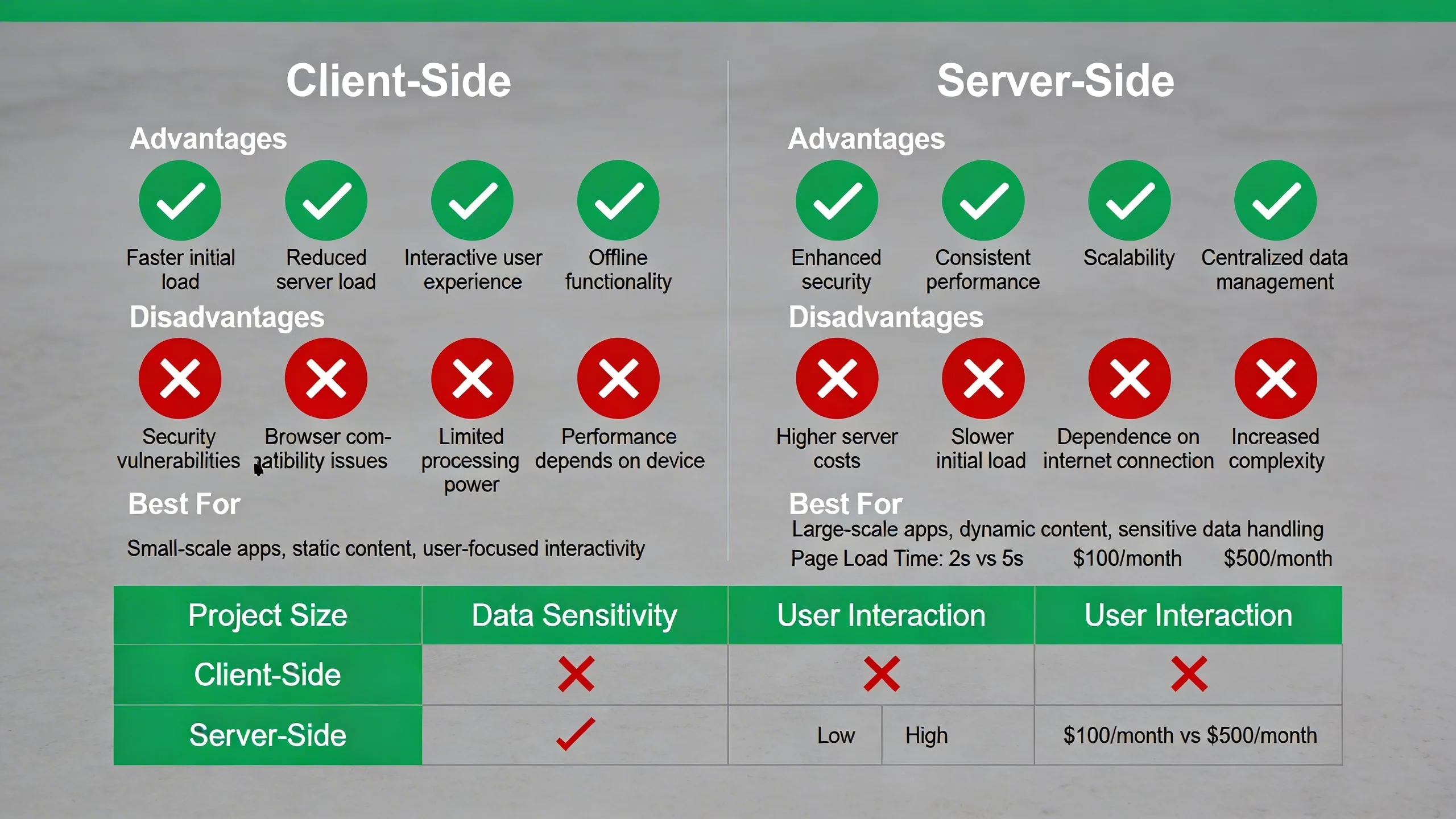
| Feature | Client-Side Header Bidding | Server-Side Header Bidding |
|---|---|---|
| Page Latency | Higher (potential for slowness with more partners) | Lower (much faster page load times) |
| User ID Sync | Excellent (direct browser access, high match rates) | Good (requires server-to-server syncing, potentially lower match rate) |
| Revenue Potential | High (excellent ID match leads to valuable bids) | Potentially Higher (more partners create more competition) |
| Transparency | High (full visibility into the auction in the browser) | Lower (auction happens off-site in a "black box") |
| # of Partners | Limited by browser (typically 5-7) | Virtually unlimited (can scale to 20+) |
| Setup Complexity | Lower (easier to start, especially with Prebid.js) | Higher (requires a server partner or self-hosted infrastructure) |
| Best For | Publishers prioritizing transparency & user match rates. | Publishers prioritizing page speed & massive scale. |
So, Which Is Right for YOUR Site? A Practical Guide
Now for the most important question. The answer isn't about which technology is universally "better," but which is the right tool for your specific job.
Choose Client-Side If...
- You are a small-to-medium publisher just starting your header bidding journey. The lower implementation complexity makes it an ideal entry point.
- You work with a curated list of fewer than 7-8 demand partners. At this scale, the latency impact is often manageable.
- Transparency and direct control over the auction are your absolute top priorities. You want to see everything that happens.
- Your primary goal is to maximize user ID match rates with your most important, high-performing partners to secure the highest possible bid value from them.
Choose Server-Side If...
- You are a large publisher with significant traffic where even milliseconds of latency can impact revenue and user retention.
- Page speed and Core Web Vitals are your absolute top priority, mandated by your SEO and development teams.
- You want to integrate with a large number of demand partners (10+) to maximize bid density across all your inventory.
- A significant portion of your revenue comes from mobile web or video advertising, where a fast, seamless experience is non-negotiable.
A Note on Google's Open Bidding
It's impossible to discuss S2S without mentioning Google's own solution, Open Bidding (formerly Exchange Bidding). Open Bidding is Google's server-to-server platform that allows third-party exchanges to compete in a unified auction run on Google's servers. For publishers heavily embedded in the Google Ad Manager ecosystem, it can be a streamlined way to access S2S demand without implementing a separate Prebid Server solution. However, it operates within Google's "walled garden," offering less flexibility and transparency than an open-source Prebid setup.
The Best of Both Worlds: The Rise of Hybrid Header Bidding
For the most sophisticated publishers, the choice isn't binary. The expert-level solution is a hybrid setup that strategically combines the strengths of both client-side and server-side auctions.
The hybrid concept is simple: you don't have to choose one or the other for all your partners. Instead, you can run a "split" auction.
How it works: You identify your top 2-4 demand partners—the ones that consistently deliver high CPMs and benefit most from high cookie match rates. You run these premium partners client-side to capture their maximum bid value. Simultaneously, you run the rest of your demand partners (your "long-tail") server-side. This allows you to scale your demand and increase competition without adding crippling latency to your site.
This approach gives you the best of both worlds: the high-value, identity-rich bids from your top partners via client-side, and the speed and scale of server-side for everyone else. This is the ultimate ad monetization optimization strategy for large-scale publishers focused on fine-tuning their setup for maximum yield and performance.
Your Next Steps: Implementing Your Chosen Strategy
Making the decision is the first step. Executing it properly is what drives results. Here's how to move forward:
- Partner with an Expert: Header bidding is complex. Whether you choose client-side, server-side, or hybrid, partnering with a monetization expert or a managed ad ops provider is highly recommended. They can manage the technical setup, ongoing optimization, and partner relationships, freeing you to focus on creating great content.
- Choose Your Wrapper/Server: Based on your decision, you'll need to select your technology. This could be the open-source Prebid.js (client-side), implementing Prebid Server (server-side), or working with a partner who provides a managed version of these technologies.
- Test, Measure, Optimize: This is not a "set it and forget it" solution. Once implemented, you must continuously monitor key metrics like page latency, ad load times, fill rates, and CPMs from each partner. A/B testing different configurations, timeouts, and partner lineups is essential to maximizing performance.
Conclusion
The choice between client-side and server-side header bidding isn't about finding a single "best" answer, but about understanding a fundamental trade-off. Client-side offers unparalleled transparency and superior user matching at the potential cost of page latency. Server-side delivers exceptional speed and scale at the cost of some transparency and potentially lower ID match rates.
Your site's scale, technical resources, and strategic priorities will dictate the right path. A smaller publisher might thrive with a simple, transparent client-side setup. A large media enterprise will almost certainly need the speed and scale of a server-side or hybrid solution to compete effectively. By understanding the core mechanics and trade-offs of each, you can move from confusion to clarity and build an ad monetization engine that drives revenue without compromising the quality of your user experience.
---
Choosing the right header bidding setup can increase your ad revenue by 20-50% or more. If you're still unsure which path is right for your site, our ad ops experts can provide a free analysis of your current stack. Schedule Your Free Consultation Today