
Part 1: Introduction - The Publisher's Dilemma
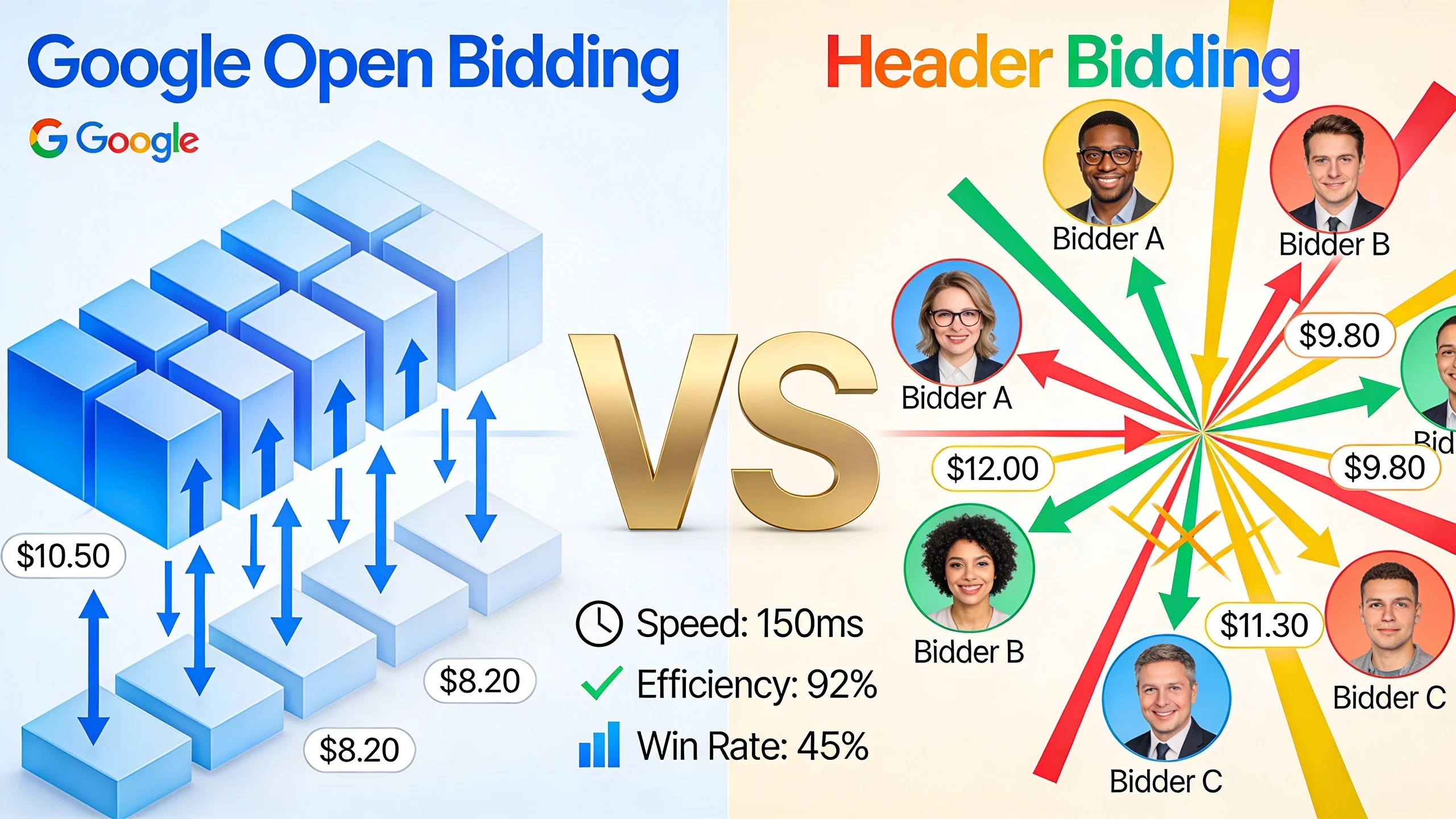
In the complex and fiercely competitive landscape of digital advertising, every publisher faces the same core challenge: how to maximize ad revenue without compromising user experience. For years, the ad tech world has been dominated by a single question: what is the most effective way to run a unified auction where all demand sources compete simultaneously for your inventory?
This question has led to two dominant, powerful, and often misunderstood solutions: Header Bidding, the open-source disruptor that leveled the playing field, and Google's Open Bidding, the tech giant's powerful server-side alternative.
Choosing between them is more than just a technical implementation; it's a strategic decision about revenue, control, and the future-proofing of your ad stack. One prioritizes ultimate transparency and demand access, while the other champions speed and simplicity.
This article will not declare a single "winner." Instead, it provides a clear, head-to-head comparison across the most critical performance and operational criteria. Our goal is to give you the unbiased framework you need to make the right choice for your specific needs, goals, and resources.
Part 2: Foundational Concepts: What Are We Comparing?
Before diving into a direct comparison, it's essential to understand the fundamental mechanics of each technology.
What is Header Bidding? (The Industry Standard)
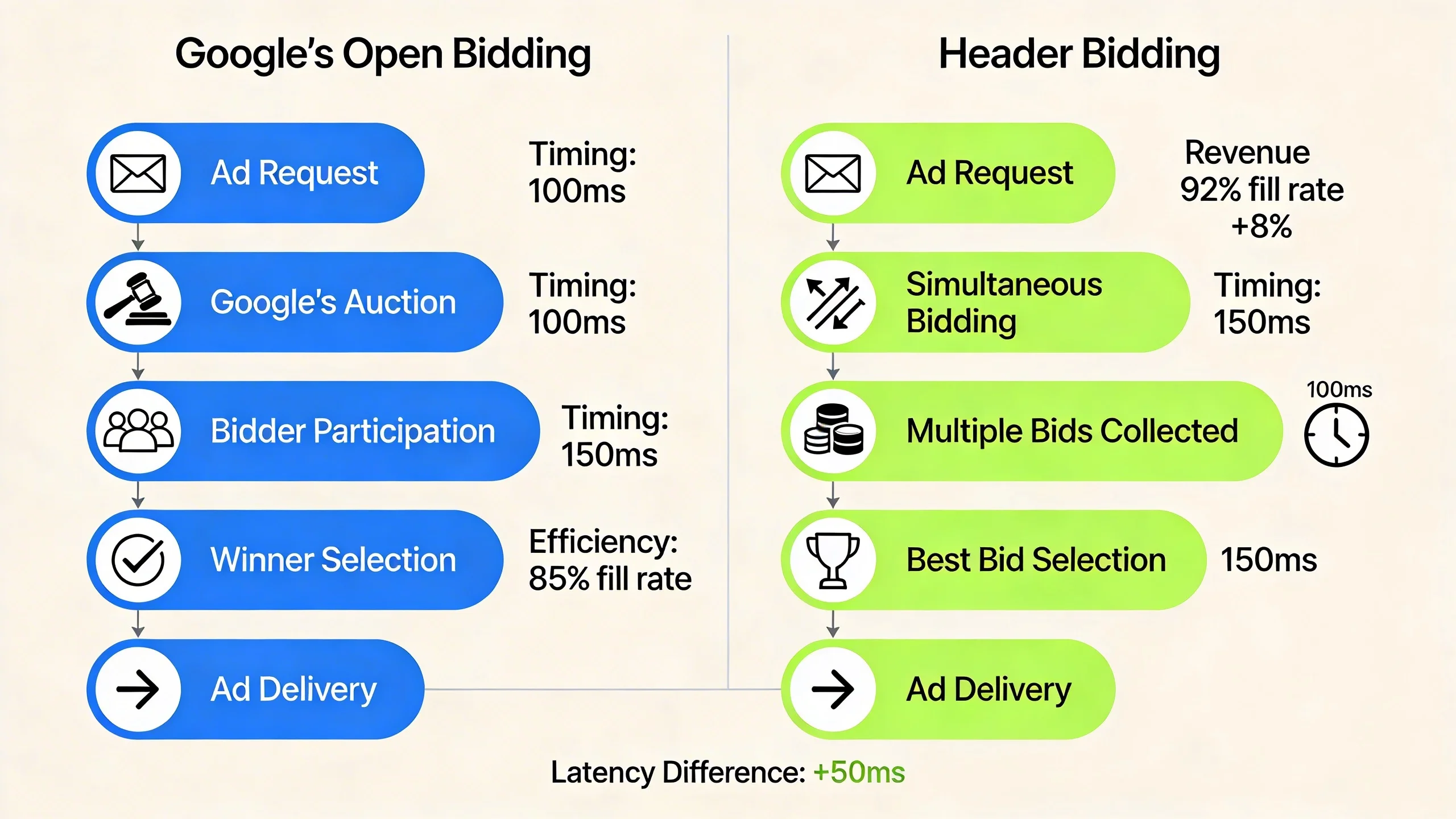
Header Bidding is a programmatic technique that allows publishers to offer their ad inventory to multiple ad exchanges, or Supply-Side Platforms (SSPs), simultaneously before making a call to their primary ad server (usually Google Ad Manager). This auction happens directly within the user's browser, typically in the <head> section of the webpage, which is how it got its name.
It emerged as a revolutionary way to bypass the inefficient "waterfall" system, where ad networks were called in a sequential, predetermined order, giving Google's ad exchange an unfair advantage. By running a unified auction upfront, Header Bidding ensures that publishers sell their ad impressions to the true highest bidder every single time. The process is managed by a piece of JavaScript called a "wrapper," with Prebid.js being the universally recognized open-source standard.
Key takeaway: Header Bidding democratized ad auctions by running a transparent, client-side auction that gives publishers direct access to more demand sources on a level playing field.
[Simple diagram showing the client-side auction flow: User visits page -> Prebid.js sends ad requests to multiple SSPs simultaneously -> SSPs return bids to the browser -> Prebid.js determines the winning bid -> Winning bid is sent to Google Ad Manager to compete with direct deals and AdX.]
What is Google's Open Bidding? (The Server-Side Challenger)
Open Bidding, formerly known as Exchange Bidding, is Google's answer to the challenges posed by Header Bidding. It is a server-to-server (S2S) unified auction that takes place directly within Google Ad Manager (GAM). Instead of the auction running in the user's browser, the publisher's ad server makes a single call to GAM, which then conducts a real-time auction on its own servers, inviting multiple third-party demand partners to bid.
The primary value proposition of Open Bidding is its ability to reduce page latency. By moving the heavy lifting of the auction from the user's browser (client-side) to powerful Google servers (server-side), it streamlines the process, reduces the number of requests the browser has to handle, and ultimately leads to faster page load times.
Key takeaway: Open Bidding simplifies the auction process and improves page speed by centralizing the auction on the server-side, all managed within the familiar Google Ad Manager ecosystem.
[Simple diagram showing the S2S auction flow: User visits page -> Google Ad Manager ad tag fires -> GAM sends a single ad request to its server -> GAM server calls multiple S2S demand partners simultaneously -> Partners return bids to GAM server -> GAM runs a unified auction to determine the final winner -> Winning ad is served to the user.]
Part 3: The Head-to-Head Comparison
Now that we understand the core mechanics, let's put these two technologies head-to-head across the factors that matter most to publishers.
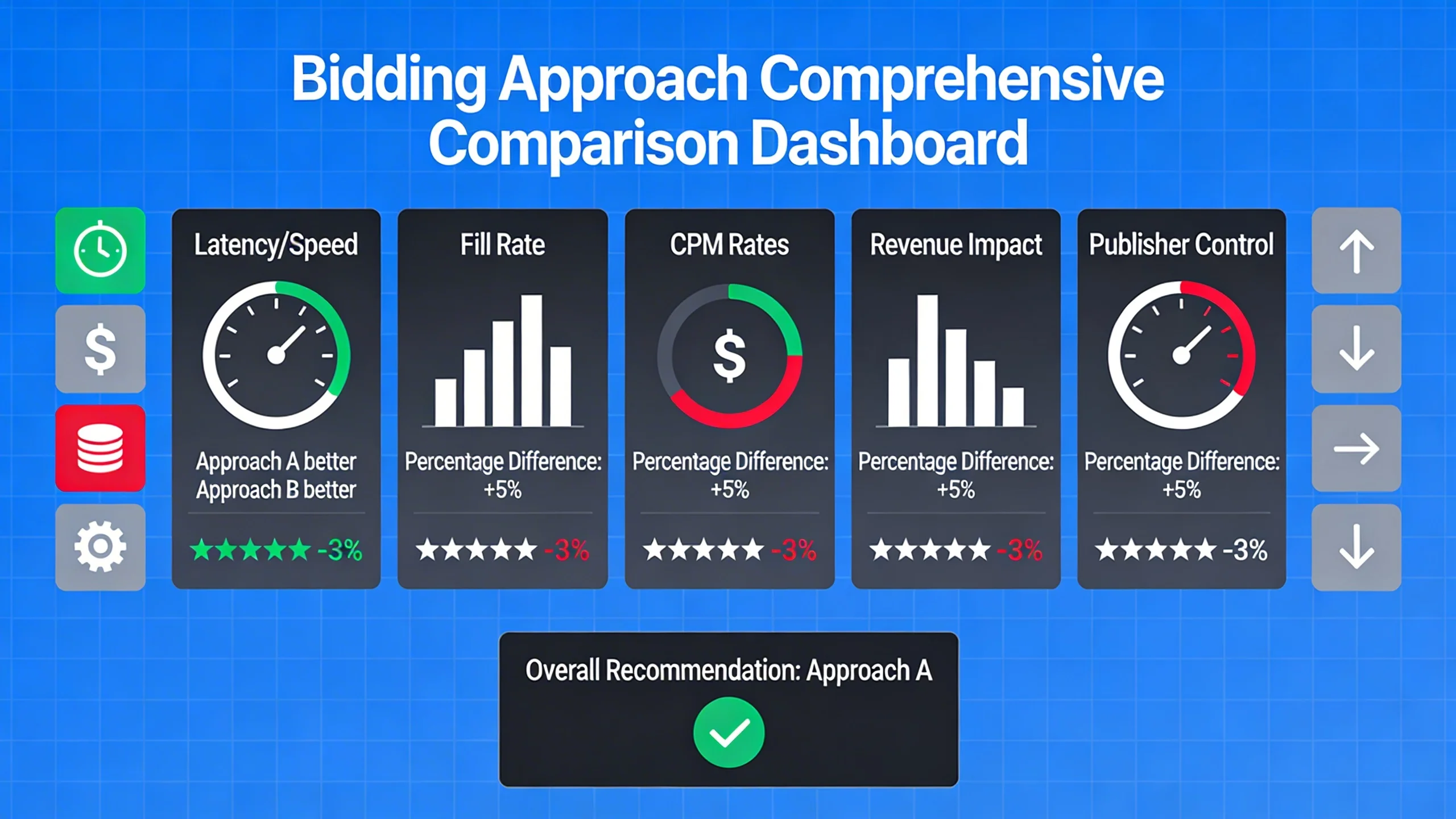
Open Bidding vs. Header Bidding: A Feature-by-Feature Breakdown
For a quick overview, here is a summary of the key differences:
| Feature | Header Bidding (Client-Side) | Open Bidding (Server-Side) |
|---|---|---|
| Auction Type | Client-Side (in browser) | Server-to-Server (in GAM) |
| Latency | Higher (browser processing) | Lower (server processing) |
| Implementation | More complex (requires dev resources, Prebid setup) | Simpler (configuration within GAM) |
| Transparency | High (open-source, full auction visibility) | Lower ("black box" within Google's system) |
| Demand Partners | Vast ecosystem (any SSP with a Prebid adapter) | Limited to Google-approved partners |
| Match Rates | Higher (direct cookie syncing in browser) | Potentially lower (relies on Google's identity matching) |
| Revenue | Potentially higher due to more demand and better match rates | Can be competitive, especially when factoring in latency gains |
| Reporting | Disparate (requires consolidation from multiple SSPs) | Centralized and streamlined within GAM reports |
---
Factor 1: Latency and Page Speed
Latency is a critical factor that impacts everything from user experience and bounce rates to SEO rankings and ad viewability.
- Header Bidding: Because the auction runs in the user's browser, each demand partner adds a small amount of JavaScript to the page. The browser must process these scripts and wait for responses, which can add hundreds of milliseconds to page load times, especially if timeouts are not configured correctly.
- Open Bidding: The S2S process is inherently faster. The user's browser makes only one call to GAM. Google's powerful servers then handle all the bidding requests in parallel. This significantly reduces the processing load on the client-side.
Verdict: A clear win for Open Bidding. If your absolute top priority is minimizing page latency and maximizing site speed, Open Bidding has a structural advantage.
Factor 2: Implementation and Maintenance
The technical resources required to set up and manage your bidding solution are a major consideration.
- Header Bidding: Implementation is more complex and hands-on. It typically requires developer resources to add the Prebid.js code to the site, configure the wrapper, set up ad units, and manage adapters for each demand partner. Ongoing maintenance is also required to update adapters and troubleshoot issues.
- Open Bidding: Implementation is significantly simpler. It's largely a configuration process within the GAM user interface. Publishers simply need to establish relationships with eligible Open Bidding partners and link them in GAM. There is far less custom code to manage on the page.
Verdict: Open Bidding is the winner for ease of implementation. It's an ideal choice for publishers with limited developer resources or those who prefer a more streamlined, "out-of-the-box" solution.
Factor 3: Transparency and Control
Understanding what happens inside the auction is crucial for optimization and trust.
- Header Bidding: Built on the open-source Prebid.js framework, Header Bidding offers maximum transparency. Publishers have full visibility into the auction logic, can see every bid from every partner, and have granular control over settings like timeouts and partner configurations. You own the code and the data.
- Open Bidding: This process is more of a "black box." The auction happens on Google's servers, and publishers have limited insight into the mechanics of how the final winner is chosen or why a specific partner may not be bidding effectively. You are reliant on Google's reporting and infrastructure.
Verdict: Header Bidding offers superior transparency and control. For publishers who want to fine-tune every aspect of their auction and have complete ownership of their setup, Header Bidding is the undisputed choice.
Factor 4: Access to Demand Partners
The more bidders in your auction, the higher the competition and, theoretically, the higher the revenue.
- Header Bidding: The Prebid ecosystem is vast and open. Hundreds of SSPs and ad exchanges have developed adapters, giving publishers access to the widest possible pool of unique demand. If a demand source exists, there is likely a Prebid adapter for it.
- Open Bidding: The list of demand partners is curated and controlled by Google. While it includes most of the major industry players, it is a smaller, more exclusive list. Not all SSPs are eligible or integrated, which can limit your access to niche or specialized demand sources.
Verdict: Header Bidding provides access to a wider and more diverse pool of demand, making it the winner for maximizing bidder competition.
Factor 5: Revenue, CPMs, and Match Rates
This is the most important—and most nuanced—comparison point. There is no universal "winner" for revenue.
- Header Bidding: Its primary revenue advantage comes from higher user match rates. Because the auction happens in the browser, SSPs have direct access to third-party cookies, allowing them to more accurately identify users and thus bid with more confidence and higher CPMs. This, combined with a wider pool of demand, can lead to a significant revenue lift.
- Open Bidding: Its revenue case is built on efficiency. The lower latency can lead to higher ad viewability and lower bounce rates, meaning more ad impressions are successfully served and seen by users. While individual CPMs might be slightly lower due to poorer cookie matching in the S2S environment, the overall revenue (RPM) can be competitive by serving more total impressions.
Verdict: This is highly dependent on the publisher's specific setup, audience geography, and demand partners. Header Bidding often wins on a pure CPM basis due to better identity matching, but Open Bidding can sometimes close the gap on an RPM basis through speed gains. The only way to know for sure is to test both.
Part 4: The Best of Both Worlds: The Hybrid Approach
For many sophisticated publishers, the debate isn't about "either/or" but "both/and." The most common advanced strategy today is a hybrid setup that combines the strengths of both client-side Header Bidding and server-side Open Bidding.
Why Choose? The Power of a Hybrid Setup
In a hybrid model, the auction flow becomes a multi-stage process designed for maximum yield:
- A client-side Header Bidding auction runs in the browser via Prebid.js.
- The winning bid from this client-side auction is passed into Google Ad Manager.
- Inside GAM, this bid then competes in a final, server-side unified auction against Google AdX, any Open Bidding partners, and any other direct-sold line items.
This approach creates the ultimate competitive environment. It leverages the high match rates and broad demand access of client-side Header Bidding while simultaneously incorporating the speed and simplicity of Open Bidding for other partners. You get the best of both worlds.
Who it's for: This setup is ideal for large, sophisticated publishers who are focused on squeezing every last drop of revenue from their inventory and have the Ad Ops expertise to manage a more complex configuration.
Want to see how a hybrid setup could work for you? [Download our free case study on Publisher X's 25% revenue lift.]
Part 5: Making Your Decision: A Practical Framework
So, how do you decide? Use this simple framework based on your primary goals and resources.
Which Bidding Strategy is Right for You?
- Choose Header Bidding if...
* You prioritize maximum transparency and control over your auction.
* You want access to the widest possible range of demand partners.
* You have the in-house technical or partner resources to implement and manage a Prebid.js setup.
* Your primary goal is to maximize CPMs through superior user matching.
- Choose Open Bidding if...
* Your primary concern is page speed and minimizing ad latency.
* You have limited developer resources and prefer a simpler, more streamlined implementation.
* You are comfortable operating within the Google ecosystem and value centralized reporting in GAM.
* Your team prioritizes operational efficiency over granular control.
- Consider a Hybrid Model if...
* You are a large publisher with significant traffic and a dedicated Ad Ops team.
* Your sole objective is to maximize yield by creating the most competitive auction possible.
* You have the expertise to manage the complexity of both client-side and server-side configurations.
Part 6: Conclusion
The choice between Google's Open Bidding and Header Bidding is a strategic trade-off. It's a balance between the speed and simplicity offered by Open Bidding's server-side approach and the transparency, control, and broad demand access of Header Bidding's client-side foundation.
There is no one-size-fits-all answer. The "best" solution is the one that aligns with your business goals, technical capabilities, and monetization philosophy. For many, the journey starts with one and evolves into a hybrid setup as their needs and expertise grow.
As the industry moves towards a future with less reliance on third-party cookies, the dynamics between client-side and server-side solutions will continue to shift. But by understanding the core principles of each, you are empowered to build an ad stack that is not only profitable today but also resilient for tomorrow.
---
Primary CTA:
Navigating the programmatic landscape is complex. If you're looking to optimize your ad stack and maximize revenue, schedule a free consultation with one of our ad monetization experts today.