

The Fundamental Valuation Formula: It’s Simpler (and More Complex) Than You Think
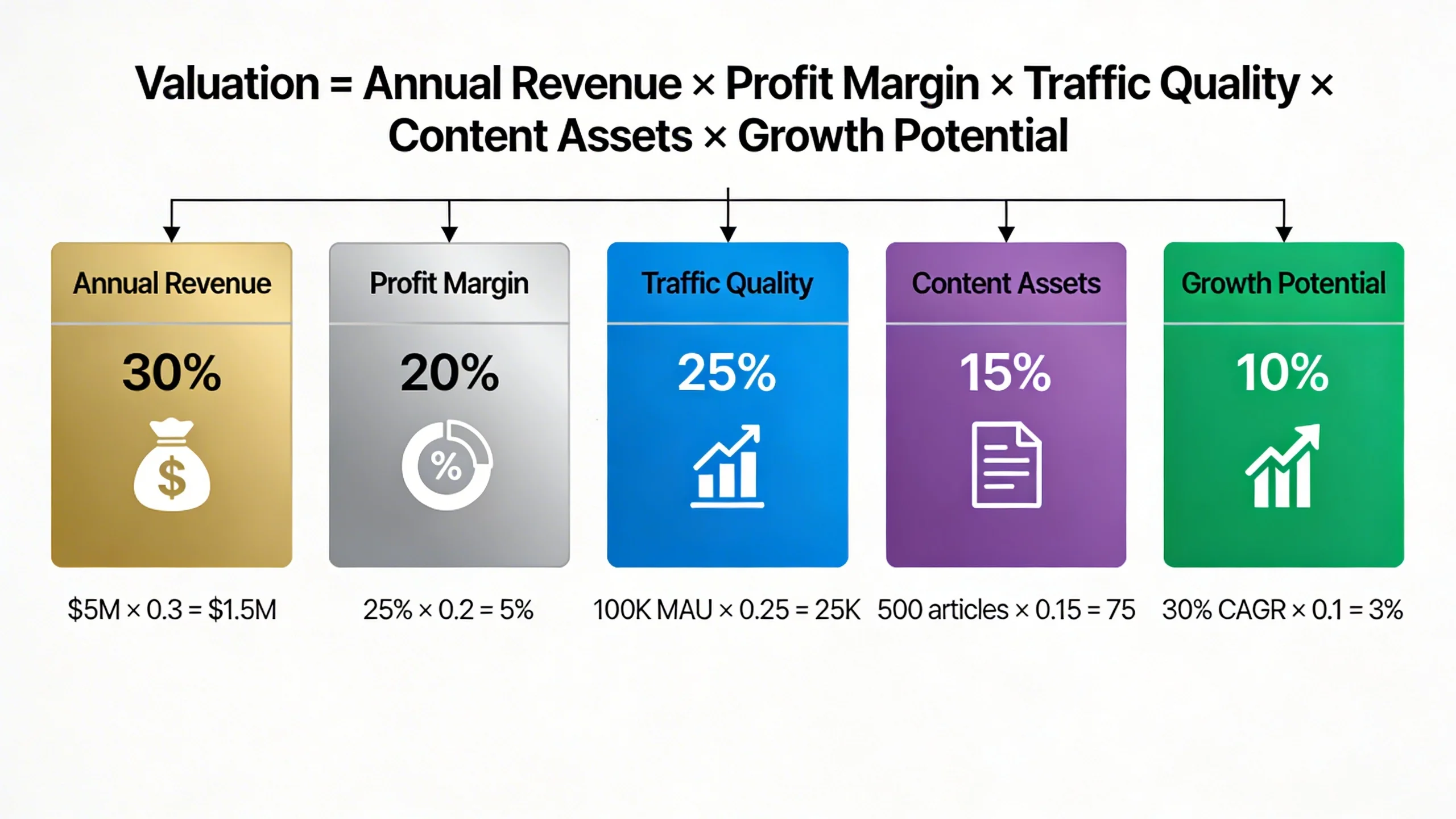
At its heart, the valuation for almost every content website sold on the market today starts with a simple, elegant formula:
Valuation = Net Profit x Multiple
For example, a website earning $5,000 per month in net profit with a 40x multiple would be valued at $200,000 ($5,000 x 40).
This is the industry-standard starting point used by the world’s top brokers, from Empire Flippers to Quiet Light. It provides a clear, mathematical basis for negotiation. However, this simplicity is deceptive. The real work, the part that separates amateur investors from professional asset managers, is in accurately calculating the two variables in that equation.
First, how do you define and verify "Net Profit" in a way that is standardized and fair to both parties? Second, how do you determine the correct "Multiple"? Is the site worth 30x, 42x, or 55x its monthly profit, and why? The remainder of this guide is dedicated to dissecting these two critical variables, giving you the tools to value any content website with confidence.
Part 1: Calculating the "Profit" - The Science of SDE
The first and most crucial step is to establish a verifiable baseline of financial performance. This is the "science" part of the valuation—it’s all about the numbers. However, we need to use the right numbers.
Why "Profit" is the Wrong Word: Introducing Seller's Discretionary Earnings (SDE)
In the world of online business sales, we rarely use the term "net profit." Instead, the gold standard is Seller's Discretionary Earnings (SDE). SDE is defined as the total financial benefit a single owner-operator derives from the business. It’s a normalized figure that shows a buyer the true profit potential of the asset if they were to step into the seller's shoes.
The formula for SDE is:
SDE = Revenue - Cost of Goods Sold (COGS) - Operating Expenses + Owner's Salary & Add-Backs
Let’s walk through how to calculate this, step by step.
Step 1: Verify All Revenue Streams
First, you must account for every dollar the website generates. Common revenue streams for content websites include:
- Display Advertising: Income from networks like IMC, Mediavine, Raptive, or Google AdSense.
- Affiliate Marketing: Commissions from programs like Amazon Associates, ShareASale, CJ Affiliate, or direct partnerships.
- Digital Products: Sales of proprietary assets like eBooks, online courses, templates, or premium content.
- Sponsored Posts: One-time payments from brands for publishing sponsored content.
For a buyer, it’s not enough to see these numbers on a spreadsheet. Verification is non-negotiable. This means requesting read-only access to dashboards, video-recorded walkthroughs of accounts, or, at a minimum, verified screenshots for every revenue source.
Step 2: Identify and Subtract Operating Expenses (OpEx)
Operating Expenses (OpEx) are the necessary costs of running the business. These are the non-negotiable expenses that will be passed on to the new owner. Common OpEx for a content site includes:
- Hosting & Domain: Annual or monthly fees for web hosting and domain renewals.
- Premium Tools & Software: Costs for premium plugins, themes, email marketing software (e.g., ConvertKit), and SEO tools (e.g., Ahrefs, SEMrush).
- Content Creation: Payments to freelance writers, editors, or content agencies.
- Staffing: Salaries or fees for virtual assistants (VAs) who manage tasks like content uploading, social media, or email support.
Every claimed expense should be subtracted from the total revenue to get closer to the true profit.
Step 3: The Power of "Add-Backs"
This is where SDE truly differs from a standard profit and loss (P&L) statement. An "add-back" is an expense that is added back into the profit calculation because it is discretionary, a one-time cost, or a personal benefit to the current owner that wouldn't be passed on to the buyer. Add-backs increase the final SDE, and therefore, the valuation.
Clear examples of legitimate add-backs include:
- Owner's Salary: If the owner pays themselves a formal salary, this is added back, as the new owner can decide to pay themselves differently or not at all.
- One-Time Costs: A $5,000 website redesign, a $2,000 professional course the owner took, or a one-time purchase of a lifetime software deal. These aren't recurring operational costs.
- Discretionary or Failed Expenses: A $1,000/month experimental Facebook ad campaign that didn't produce ROI and was shut down. The new owner isn't obligated to continue this expense.
- Personal Expenses: A portion of a cell phone bill, personal travel, or a home office expensed through the business. These are benefits to the current owner, not essential business costs.
Be wary of sellers who try to "add back" essential costs. For example, you cannot add back the cost of freelance writers if the site requires new content to sustain its traffic and revenue.
The Final Calculation: Averaging Your SDE
Finally, to get the most accurate picture of the business's health, you should never rely on a single month's performance. The industry standard is to calculate the trailing 6 or 12-month average SDE. This smooths out seasonality (e.g., a Q4 holiday shopping spike for an affiliate site) and any other anomalies, providing a stable and defensible profit figure.
Example SDE Calculation (Trailing 6 Months):
| Month | Total Revenue | Total OpEx | Add-Backs | Monthly SDE |
|---|---|---|---|---|
| Jan | $12,000 | $2,500 | $500 | $10,000 |
| Feb | $11,500 | $2,300 | $0 | $9,200 |
| Mar | $13,000 | $2,600 | $1,000 | $11,400 |
| Apr | $12,500 | $2,400 | $0 | $10,100 |
| May | $12,800 | $2,800 | $0 | $10,000 |
| Jun | $14,000 | $3,100 | $0 | $10,900 |
| Total | $75,800 | $15,700 | $1,500 | $61,600 |
| Average Monthly SDE | $10,267 |
In this example, $10,267 is the number we will use in our valuation formula.
Part 2: Determining the "Multiple" - The Art of Risk Assessment
If calculating SDE is the science, determining the multiple is the art. The multiple (typically expressed as a multiplier of monthly SDE, e.g., 30x-50x) is a direct reflection of the asset's quality, stability, and future growth potential. In essence, it’s a measurement of risk. A lower-risk, higher-quality asset commands a higher multiple.
Let's break down the seven key factors that influence the multiple.
H3: Factor 1: Age & History
A website that has been established for 5+ years with a clean, consistent history is inherently less risky than a 1-year-old site that has seen rapid, unproven growth. An older domain has likely weathered multiple Google algorithm updates, established a level of authority, and proven its business model. A longer track record of stable earnings justifies a higher multiple.
H3: Factor 2: Traffic Quality & Diversity (The 3 Pillars)
Where the traffic comes from is one of the most critical valuation factors. Over-reliance on a single source is a major red flag. A high-quality site has a healthy mix of traffic from what we call the three pillars:
- SEO (Organic Search): This is the gold standard. Strong, diversified organic traffic from Google is a sign of a sustainable, long-term asset. A buyer must check if the site has been resilient to recent Google core updates.
- Direct/Email: This indicates strong brand recognition and a loyal, returning audience. A large, engaged email list is a massive asset that significantly increases the multiple.
- Social/Referral: Traffic from sources like Pinterest, Facebook, or other websites is good, but it can be volatile and dependent on platform algorithms.
Red Flag: A site where 95% of its traffic comes from a single source, like Pinterest or one specific referring domain, is extremely risky. A single algorithm change could wipe out the business overnight, justifying a much lower multiple.
H3: Factor 3: Content Quality & "Moat"
In today's AI-driven world, the quality of content and the defensibility of a business—its "moat"—are paramount. Ask these questions:
- E-E-A-T: Does the content demonstrate Google's principles of Experience, Expertise, Authoritativeness, and Trustworthiness?
- Evergreen vs. Trendy: Is the content timeless and likely to remain relevant for years, or is it based on fleeting trends?
- Replicability: How easily could a competitor (or an AI tool) replicate the site's content?
A strong moat that increases the multiple could be proprietary data, unique expert interviews, a community forum, a custom-built tool, or a powerful, recognizable brand.
H3: Factor 4: Monetization Diversity & Stability
Similar to traffic diversity, having multiple, stable income streams drastically reduces risk. A site earning $10,000/month from four different sources (e.g., IMC, Amazon Associates, a private affiliate, and an eBook) is far more valuable than a site earning the same amount solely from the Amazon Associates program. The latter is vulnerable to a single commission rate change. A buyer will also analyze the stability of these streams—are ad RPMs stable or declining? Are affiliate partners reliable?
H3: Factor 5: Niche & Market Trends
The niche the website operates in has a huge impact on its multiple. A site in a growing, evergreen niche (e.g., home improvement, pet care) is generally more desirable than one in a dying fad (e.g., a specific video game that is losing popularity). Use a tool like Google Trends to check the long-term interest in the site's main topics. Furthermore, highly regulated or competitive "YMYL" (Your Money, Your Life) niches like finance or health can be riskier and may require a buyer with specific credentials, potentially limiting the buyer pool and affecting the multiple.
H3: Factor 6: Operations & Time Commitment
Is the business a well-oiled machine or a chaotic, owner-reliant operation? A business that is more passive and requires fewer hours per week to maintain will command a higher multiple. The existence of well-documented Standard Operating Procedures (SOPs) for key tasks like content creation, publishing, and promotion is a massive value-add. It proves to a buyer that the business is a transferable system, not just a job dependent on the unique skills of the seller.
H3: Factor 7: Backlink Profile & Domain Authority
A website's backlink profile is a fundamental pillar of its SEO strength. A clean, natural profile with links from high-authority, relevant websites is a significant asset that supports a higher multiple. During due diligence, a savvy buyer will conduct a thorough backlink audit.
Red Flag: Any evidence of using private blog networks (PBNs), spammy link schemes, or a high volume of low-quality, toxic links will crush the multiple. These black-hat tactics create immense risk, as a future Google penalty could destroy the site's organic traffic.
Putting It All Together: A Step-by-Step Valuation Walkthrough
Now that you understand the two core components, here is a concise, step-by-step process to perform a valuation:
- Gather Financials: Collect the last 12 months of detailed profit and loss (P&L) statements. Ensure you have verifiable proof for all revenue and expense line items.
- Calculate Average SDE: Go through the P&L month by month, subtracting operational expenses and adding back any legitimate discretionary costs. Calculate the 12-month average SDE. This is your core profit number.
- Score the "Multiple Factors": Systematically analyze the website against the 7 factors discussed above (Age, Traffic, Content, Monetization, Niche, Operations, Backlinks). Be objective and identify both strengths and weaknesses.
- Research Comparables: Look at public listings on marketplaces like Flippa's "Editor's Choice" or the sold listings on Empire Flippers. Find businesses in similar niches with similar revenue levels and see what multiples they are being listed or sold for. This provides a real-world sanity check.
- Establish a Multiple Range: Based on your analysis in step 3 and your research in step 4, determine a justifiable multiple range. For example, a strong, stable site might fall in the 40x-48x range, while a riskier site might be closer to 32x-38x.
- Calculate the Final Valuation: Multiply your average monthly SDE by your determined multiple range. This gives you a logical, data-backed valuation range. For example, a site with a $10,000 SDE and a 38x-42x multiple range has a valuation of $380,000 - $420,000.
Common Valuation Pitfalls & Red Flags to Watch For
During your analysis, be on high alert for these common red flags that can signal a flawed or inflated valuation:
- Sudden, Unexplained Traffic Spikes or Drops: A recent "hockey stick" growth in traffic that doesn't have a clear cause (e.g., a viral post, a major SEO win) could be artificial or unsustainable.
- Declining Trends: A clear downward trend in traffic or revenue over the last 3-6 months is a major warning sign that the business is deteriorating. The valuation should be adjusted down significantly.
- Hidden PBNs or Bad Links: Sellers may not disclose risky link-building tactics. A tool like Ahrefs or Semrush is essential for independent backlink analysis.
- Aggressive Add-Backs: A seller claiming essential business costs (like content or a necessary VA) as discretionary add-backs is misrepresenting the site's true profitability.
- Over-reliance on the Owner: If the site's success is tied to the owner's personal brand, face, or unique expertise, it will be very difficult to transfer, thus lowering its value.
Beyond the Formula: Valuing Intangible Assets
While the SDE x Multiple formula covers the vast majority of a site's value, certain intangible assets can add a premium. These are factors that may not show up directly in the SDE calculation but create significant long-term potential. These can help push a valuation to the higher end of its determined range.
- A Large, Engaged Email List: An email list is a direct, owned communication channel with a loyal audience. A list with high open and click-through rates is an incredibly valuable asset.
- Significant, Active Social Media Following: While social traffic can be fickle, a large and genuinely engaged following on platforms like Instagram, YouTube, or Facebook provides a powerful marketing and brand-building tool for a new owner.
- Strong Brand Recognition & Trademark: A memorable brand that has earned trust and recognition in its niche is a powerful moat. A registered trademark is a legal asset that adds defensible value.
Conclusion
An accurate valuation is not found in a simple calculator; it’s derived from a rigorous process. By combining verifiable numbers (the science of SDE) with a rigorous qualitative assessment (the art of the multiple), you can build a complete and defensible picture of a content website's true worth.
For sellers, this process ensures you price your asset correctly to maximize your exit. For buyers, it is the foundation of your due diligence, protecting you from overpaying and helping you spot truly valuable opportunities. This framework is your guide to moving forward, empowering you to make smarter, more confident investment decisions in the world of digital assets.