Demystifying the CDN: Your Website's Global Express Lane
Before we dive into the dollars and cents, let's clarify what a CDN actually is. Forget the technical jargon for a moment and imagine your website is a specialty coffee roastery based in Los Angeles. Your "origin server" is this main roastery where all the beans (your website's content) are stored.
Now, if a customer in London wants your coffee, they have two options. They could place an order that has to travel all the way from Los Angeles, taking days to arrive. That’s a slow, high-latency experience.
Or, you could partner with a global chain of premium coffee shops. You send your beans in advance to local shops in London, Tokyo, and Sydney. Now, when the London customer wants a cup, they get it instantly from their local shop. The coffee is fresh, the delivery is immediate, and the customer is happy.
A CDN is that global chain of coffee shops for your website.
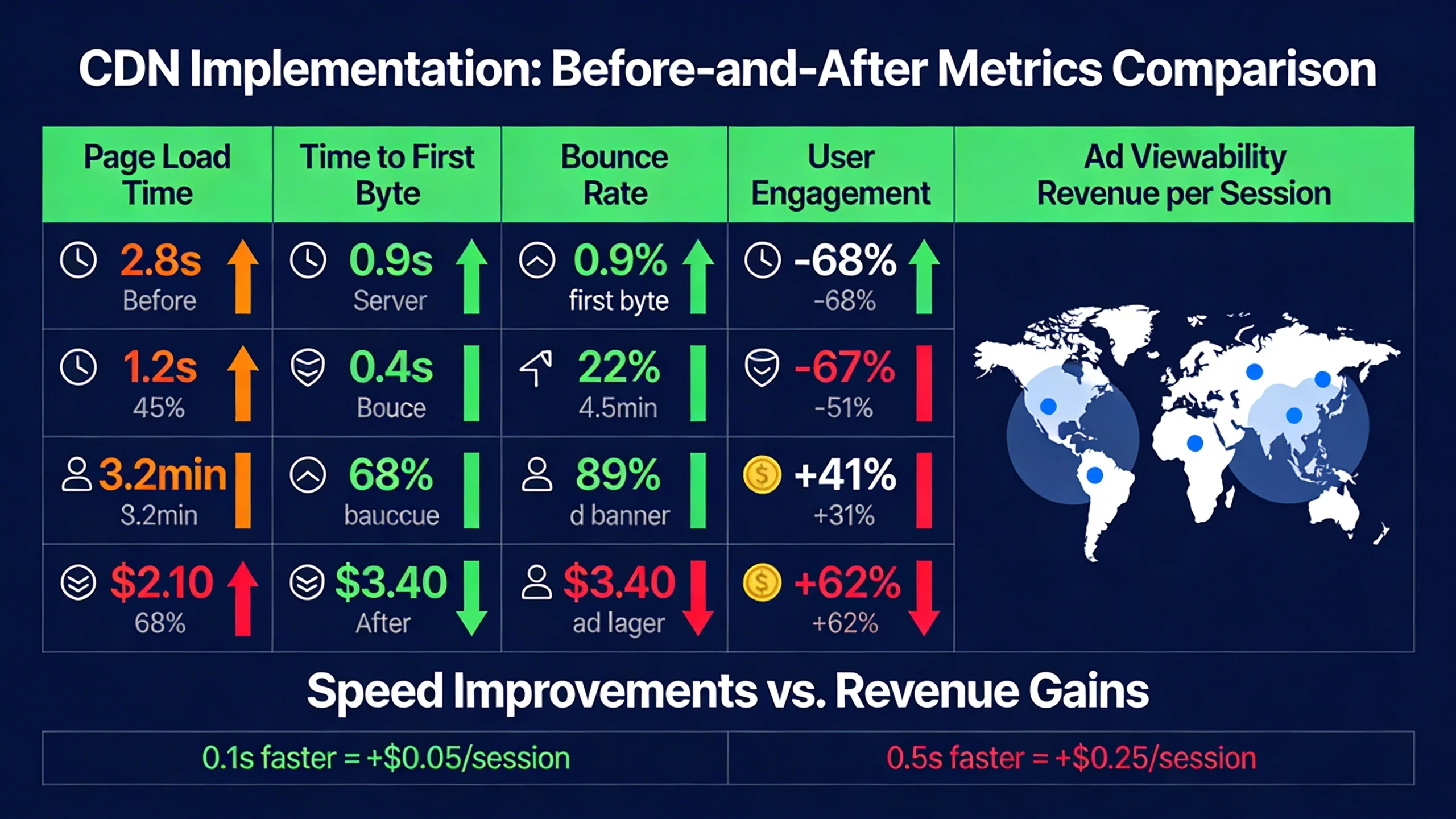
[Image: A simple diagram showing a user in London making a request. The "Without CDN" path shows a long, slow arrow to a server in Los Angeles. The "With CDN" path shows a short, fast arrow to a nearby CDN Edge Server in London.]
The Core Components: Origin Server vs. Edge Servers
- Origin Server: This is your primary web hosting server. It’s the single source of truth for your website's files, from your logo to your latest blog post. When you operate without a CDN, every single user in the world has to fetch data from this one location.
- Edge Servers: These are the "local coffee shops." A CDN provider maintains a massive, geographically distributed network of these servers. They are strategically placed in data centers all over the world, from Frankfurt to Singapore to São Paulo.
The Magic of Caching: How a CDN Remembers Your Content
The process that makes this all work is called caching. When a user first requests your website, the CDN's edge server closest to them pulls the static assets—like images, CSS files, and JavaScript—from your origin server. It then stores, or "caches," a copy of these files.
The next time a user from that same region visits your site, the edge server delivers those cached files almost instantly. It doesn't need to make the long, slow trip back to your origin server. This simple act of closing the physical distance between your content and your user is the foundational principle of a faster web.
From Lag to Lightning: 4 Ways a CDN Obliterates Latency
A CDN doesn't just make your site a little bit faster; it fundamentally re-architects how your content is delivered, attacking the root causes of slowness from multiple angles. This results in dramatic improvements to your site's performance and Core Web Vitals.
1. Slashing Physical Distance (The #1 Speed Killer)
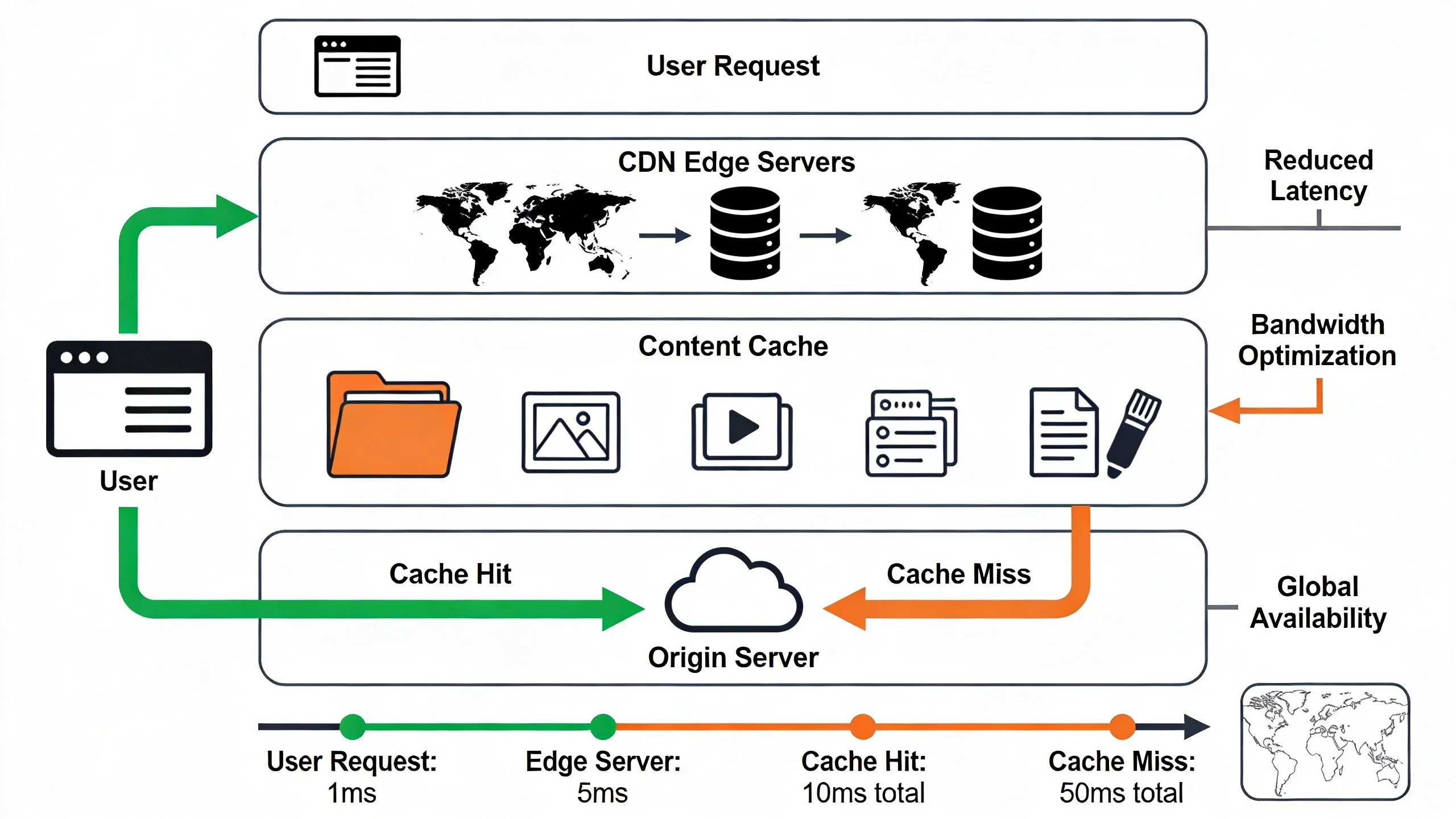
The biggest bottleneck for any website is latency—the time it takes for a packet of data to travel from the server to the user's browser. This is governed by the laws of physics; light can only travel so fast through fiber optic cables. By placing copies of your content on edge servers around the globe, a CDN reduces the physical distance that data needs to travel from hundreds or thousands of miles to just a few. This is the single most significant speed improvement a CDN provides.
2. Unburdening Your Origin Server (Reducing TTFB)
When every visitor request hits your single origin server, it can quickly become overwhelmed, especially during traffic spikes. This overload increases the Time to First Byte (TTFB), which is the time a browser has to wait before it even starts receiving the first piece of data.
A CDN offloads the vast majority of requests (for images, CSS, etc.) to its global network. This frees up your origin server's resources to do its most important job: quickly generating the core HTML of the page for the initial request. A lower TTFB is a critical factor for both user experience and SEO.
3. Advanced Asset Optimization on Autopilot
Modern CDNs are far more than just a caching network. They are performance platforms that include a suite of powerful optimization features that run automatically, saving you countless hours of manual work. These often include:
- Automatic Image Compression: Compressing images and converting them to next-gen formats like WebP on the fly, dramatically reducing file size without sacrificing quality.
- Minification: Automatically removing unnecessary characters (like spaces and comments) from CSS and JavaScript files to make them smaller and faster to download.
- Gzip/Brotli Compression: Using advanced algorithms to compress files before sending them to the browser, significantly reducing transfer times.
4. Modern Protocols for a Faster Web
Web browsers and servers communicate using protocols. Older protocols could only download one file at a time. Modern protocols like HTTP/2 and HTTP/3, which are standard on most CDNs, allow for parallel asset loading. This means the browser can request and download multiple images, scripts, and stylesheets simultaneously over a single connection, drastically speeding up page rendering. Implementing this on your own server can be complex; a CDN handles it with the flip of a switch.
The Publisher's Payday: How Milliseconds Translate into Dollars
Now we arrive at the heart of the matter. Speed is not just a technical metric; it is a direct driver of revenue. For publishers who rely on display advertising, the connection is so direct it's almost a 1:1 correlation.
Let's first look at the vicious cycle of a slow, ad-heavy site. A user clicks a link. The page begins to load. The text appears, and they start reading. A few seconds later, the heavy ad scripts finally execute, and ads pop into place, causing the entire layout to shift. The user, frustrated by the delay and the jarring experience, clicks the back button. You've lost a pageview, and the advertiser has lost a potential customer.
A CDN flips this script entirely. Here’s how it directly impacts the metrics that determine your paycheck.
Metric #1: Skyrocketing Ad Viewability
Ad Viewability is arguably the most important metric in modern display advertising. It's the measure of whether an ad was actually seen by a human. The industry standard (defined by the IAB) is that an impression is only "viewable"—and therefore, something an advertiser will pay top dollar for—if at least 50% of its pixels are on the screen for at least one continuous second.
The CDN Impact: On a slow site, by the time the ad slot and the creative finally load, the user has often already scrolled past that part of the page. The impression is recorded, but it’s not viewable, making it low-value. A CDN loads the entire page structure, including the ad slots, almost instantly. This means the ads are rendered and ready before the user scrolls past them, dramatically increasing the percentage of viewable impressions. This is the most direct link between a CDN and your ad revenue.
Key Takeaway: Higher Ad Viewability is a direct result of faster page rendering. Advertisers pay premium prices for viewable inventory, immediately increasing your effective CPMs.
Metric #2: Increasing Your CPMs
CPM stands for Cost Per Mille, or the price an advertiser pays for 1,000 ad impressions. Not all inventory is created equal. Advertisers are willing to bid significantly more for placements on high-quality sites.
The CDN Impact: What defines a high-quality site? Speed, engagement, and high viewability. A fast-loading, snappy website powered by a CDN is seen as premium inventory in the programmatic advertising ecosystem. Automated bidding systems recognize that users stay longer and see more ads on your site, and they will increase their bids accordingly. A faster site directly commands higher CPMs.
Metric #3: Improving Your Ad Fill Rate
Fill Rate is the percentage of ad requests that successfully get filled with an ad. On slow sites, complex ad auctions (like header bidding) can "time out" before they complete. The connection is too slow, the browser gives up, and the ad slot is left empty. That's a 100% loss of potential revenue for that spot.
The CDN Impact: By providing a faster, more stable connection between the user's browser and the various ad servers, a CDN ensures that more ad auctions can complete successfully within the allotted time. This leads to a higher fill rate, meaning more of your ad slots are filled with paying ads instead of being left empty.
Metric #4: Boosting Pageviews Per Session
The ultimate goal for any publisher is to get a visitor to consume more than one piece of content. This is measured by Pageviews Per Session.
The CDN Impact: When a user clicks an internal link on your site and the next page loads instantly, they are far more likely to continue exploring. A fast, fluid user experience encourages deeper engagement. A 10% increase in pageviews per session translates directly to a 10% increase in total ad impressions, and therefore, a 10% increase in revenue from that visitor. As Google found in a landmark study, as page load time goes from 1 second to 3 seconds, the probability of a bounce increases by 32%. A CDN keeps you on the right side of that statistic.
The SEO Dividend: Why Google Rewards CDN-Powered Sites
The benefits of a CDN create a powerful flywheel effect. The speed improvements that boost your ad revenue also send incredibly strong positive signals to search engines like Google, resulting in better rankings, more organic traffic, and—you guessed it—even more revenue.
Conquering Core Web Vitals (CWV)
Core Web Vitals are a set of specific performance metrics that Google uses to measure user experience. They are a confirmed ranking factor, and a CDN directly improves all three:
- LCP (Largest Contentful Paint): Measures how quickly the largest element on the page (usually a hero image or block of text) becomes visible. A CDN delivers these large assets faster, directly improving your LCP score.
- FID (First Input Delay): Measures how quickly the browser responds to a user's first interaction (like a click). By offloading work from the origin server and delivering optimized code, a CDN reduces the amount of time the browser's main thread is blocked, improving FID.
- CLS (Cumulative Layout Shift): Measures visual stability, penalizing pages where content jumps around as it loads. By ensuring ad containers, images, and fonts load near-instantly, a CDN prevents the layout shifts that plague slow sites and crush CLS scores.
Better Crawl Budget and Indexing
Googlebot has a limited amount of time it will spend crawling your site (your "crawl budget"). If your site is fast, Googlebot can crawl and index more pages in the same amount of time. This is especially crucial for large sites, ensuring your new content gets discovered and ranked more quickly.
The Trust Signal of HTTPS
Security is a non-negotiable for Google. Running your site over HTTPS (with an SSL certificate) is a known ranking factor. Most modern CDNs offer a free, one-click SSL certificate, making it incredibly easy to secure your site, build user trust, and satisfy Google's requirements.
Beyond Revenue: The "Insurance Policy" Benefits of a CDN
Beyond boosting your revenue, a CDN also serves as an essential insurance policy to protect the business you've built. It provides a level of security and reliability that is nearly impossible to achieve with a single hosting server.
Unmatched Security: DDoS and Bot Mitigation
A Distributed Denial of Service (DDoS) attack can flood your origin server with malicious traffic, taking your website completely offline for hours or even days. Every minute your site is down is a minute you are earning zero ad revenue. A CDN acts as a massive frontline shield. Its distributed network can absorb and mitigate even the largest DDoS attacks, keeping your site online and your revenue stream flowing. Many CDNs also include a Web Application Firewall (WAF) to block bots and other threats.
Flawless Uptime and Scalability
What happens when one of your articles goes viral on social media and your traffic suddenly spikes by 10,000%? For a normal hosting server, the answer is often a crash. The server overloads and your site goes down, right at the moment of your biggest opportunity. A CDN's global network is built to handle massive, unpredictable traffic spikes with ease. It automatically scales to meet the demand, ensuring your site stays online and you can fully monetize that peak traffic.
Conclusion: Stop Leaving Money on the Table
In the digital economy, a Content Delivery Network is not a technical expense; it's a revenue-generating investment with an ROI that is both immediate and compounding.
By solving the fundamental problem of latency, a CDN sets off a chain reaction of positive outcomes. It creates a superior user experience, which directly boosts the ad performance metrics that matter most: viewability, CPMs, and fill rates. This, in turn, increases your revenue. That same speed enhancement is rewarded by Google with higher search rankings, driving more organic traffic to your now high-performing, high-earning pages. The revenue you gain often dwarfs the modest cost of the CDN itself.
Stop leaving money on the table. The fastest way to increase your site's profitability is to first increase its speed.
Ready to see the impact for yourself? Start by running your site through Google's PageSpeed Insights to get your baseline score. Then, explore how leading CDN providers like Cloudflare, Ezoic, or BunnyCDN can transform your performance and your bottom line.