

What is Google AdSense & How Does It Work? (A Quick Primer)
Before we dive into the pros and cons, let's establish a baseline. Google AdSense is an advertising network run by Google that allows website owners (publishers) to display targeted ads on their sites. Advertisers bid to appear on your site, and you get paid when a user clicks an ad (Cost-Per-Click or CPC) or, in some cases, when an ad is simply viewed (Cost-Per-Mille or CPM).
Think of it like this: AdSense is like renting out small, automated "billboards" on your website. Google acts as the real estate agent, finding advertisers to fill those spots, collecting the rent, and giving you a cut (specifically, 68% of the revenue). Compare that to IMC's 90/10 revenue share, where you keep 90% of the ad revenue.
The basic requirements to get started are straightforward:
- You must own and control your website.
- Your site needs to have unique, high-quality content.
- You must adhere to Google's extensive program policies.
For beginners, this accessibility is its greatest appeal. But as we'll see, that ease of entry comes with significant trade-offs.
The "Good": Why Millions of Publishers Start with AdSense (The Pros)
To be fair and build trust, we must acknowledge where AdSense shines. It became the industry standard for a reason, and for many publishers, it’s the perfect starting point.
Unmatched Accessibility & Ease of Setup
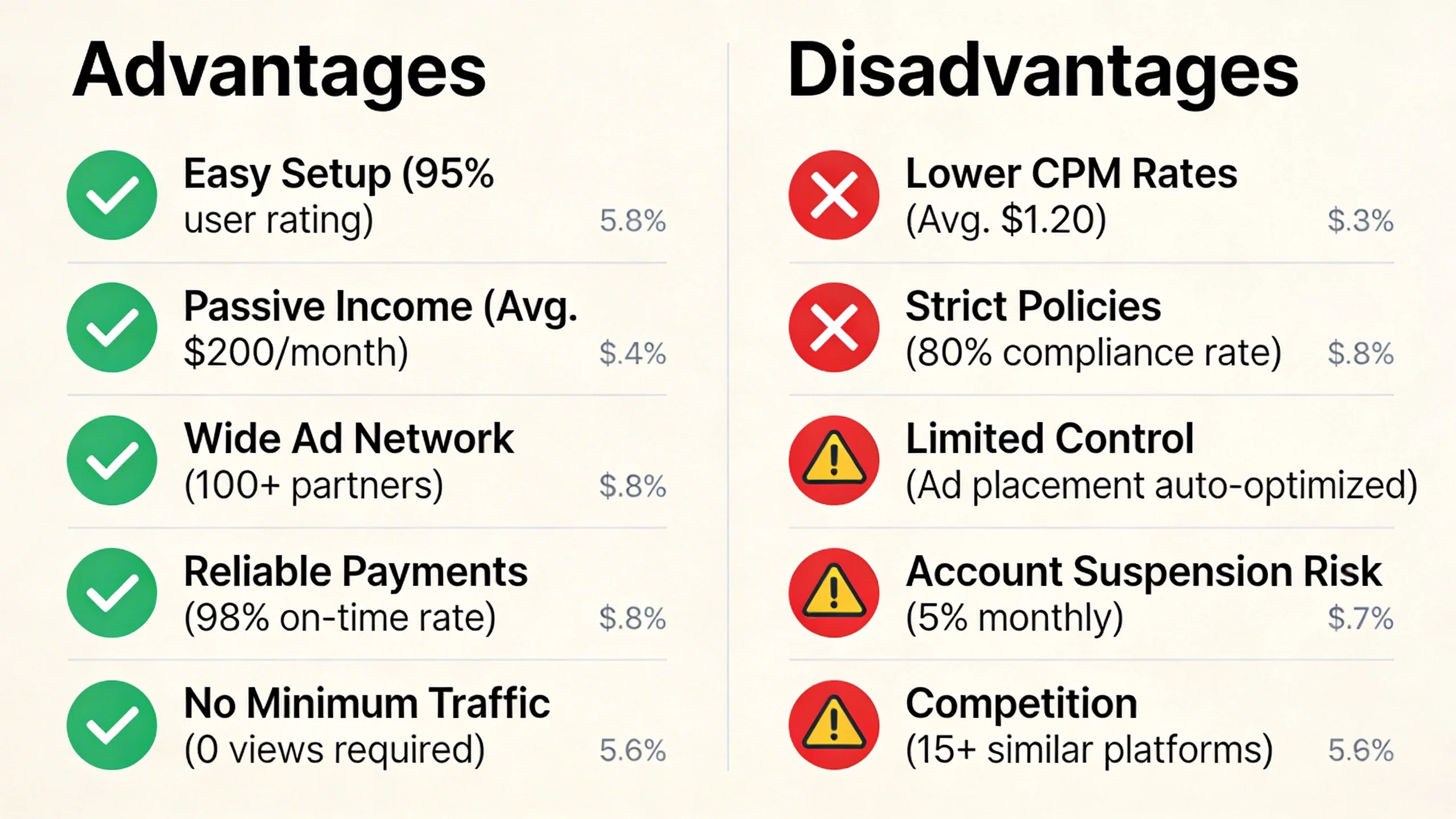
The single biggest advantage of AdSense is its incredibly low barrier to entry. Unlike premium ad management companies that require significant traffic (e.g., IMC requires 250,000+ monthly pageviews), AdSense is open to almost anyone with a legitimate website. The approval process is relatively quick, and once you're in, implementing the ads is as simple as copying and pasting a snippet of code. Google's "Auto ads" feature takes this a step further, automatically placing ads on your site with zero manual effort. For a blogger just starting their monetization journey, this simplicity is invaluable.
The Power of Google's Brand and Reliability
When you're dealing with your income, trust is paramount. AdSense is backed by Google, one of the largest and most reputable tech companies on the planet. This means you can be confident that payments will be accurate and on time (as long as you meet the threshold). There are no shady operations or fly-by-night companies to worry about. This peace of mind is a significant draw for publishers who want a set-it-and-forget-it, reliable system.
Huge Advertiser Pool and High Fill Rate
Google Ads is the largest advertising platform in the world. This means there is a colossal pool of advertisers competing for ad space across the internet. For you as a publisher, this translates to an exceptionally high "fill rate." A fill rate is the percentage of ad requests that are successfully filled with an ad. With AdSense, it’s almost always 100%. You’ll rarely, if ever, have a blank ad space on your site because Google can almost always find someone willing to advertise there.
Decent Customization (For a Beginner)
While it pales in comparison to advanced systems, AdSense does offer a respectable level of control for newcomers. You can create different ad units (display, in-feed, in-article), control their sizes, and do some basic A/B testing on their placement and style. You can also block certain sensitive ad categories or even specific advertiser URLs. For someone who has never run ads before, these tools are a good introduction to the world of ad optimization.
The "Bad & The Ugly": The Honest Downsides of AdSense (The Cons)
This is where the honest part of the review comes in. While AdSense is a great starting block, relying on it long-term can mean leaving a staggering amount of money on the table and even damaging your brand.
The Elephant in the Room: Low Revenue & RPMs
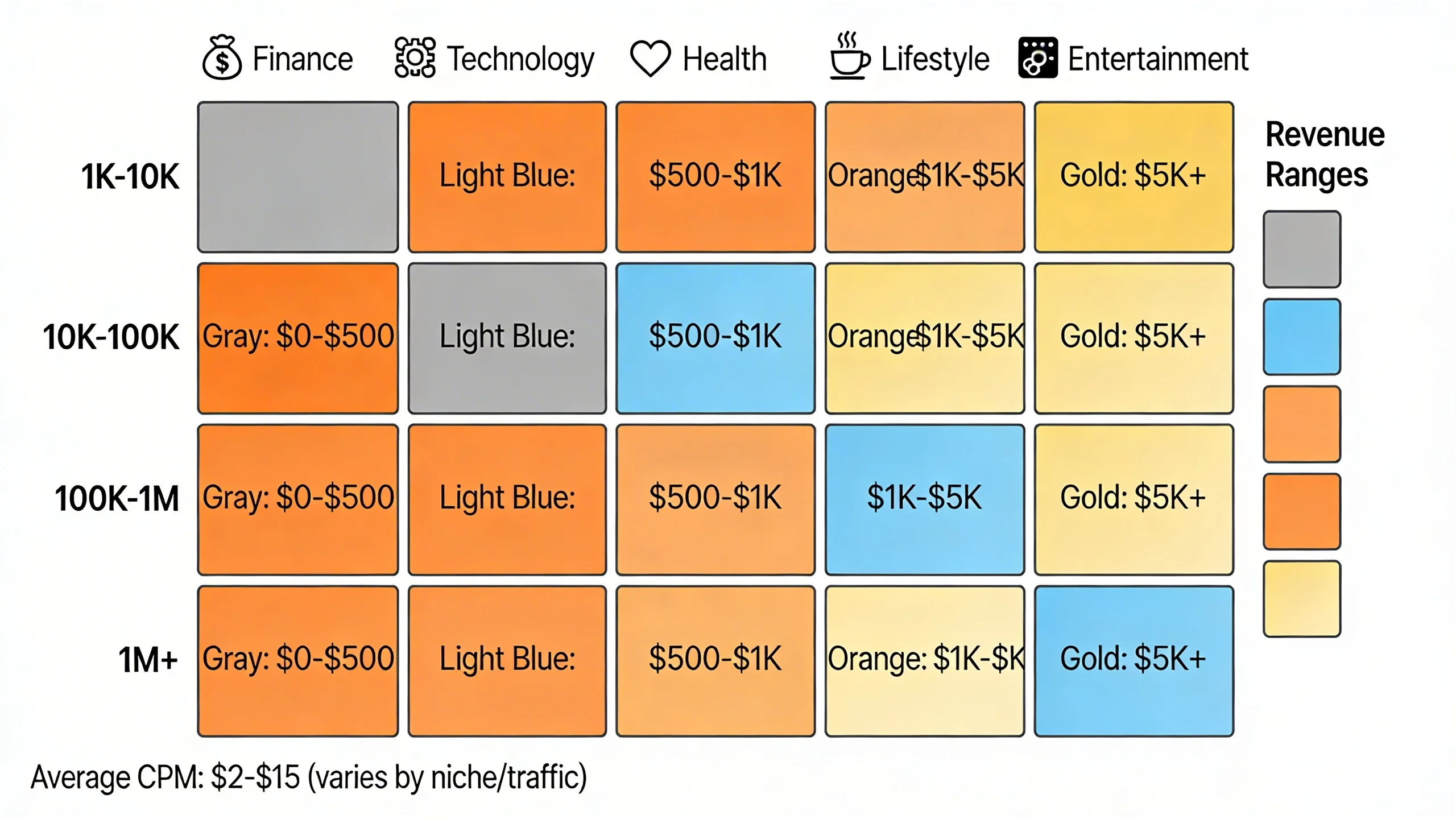
This is the number one complaint from publishers. AdSense RPMs are notoriously low. RPM stands for Revenue Per Mille, or how much you earn for every 1,000 pageviews. While it varies wildly by niche (a finance blog will earn more than a hobby blog), it's common for AdSense publishers to see RPMs in the $1 - $15 range. You could be getting 100,000 monthly visitors and still struggle to make a meaningful income. The reason is simple: AdSense is a single, closed ecosystem. Advertisers only compete against other advertisers within Google's network, which keeps bids relatively low. You are getting a slice of a much smaller pie.
The Performance Hit: AdSense Can Drastically Slow Down Your Website
Have you ever visited a site that was so bogged down with ads it was painful to use? That’s often the AdSense effect. The standard ad code from AdSense involves multiple server requests and isn't optimized for modern web standards. This can have a devastating impact on your site's Core Web Vitals (CWV)—the speed and user experience metrics that Google itself uses as a ranking factor. It's a cruel irony: the tool Google provides to monetize your site can cause Google to rank your site lower, reducing your traffic.
A Lack of Control and Poor Ad Quality
While you have some basic controls, you ultimately have little say over the quality of ads that appear. Have you ever seen a cheap, spammy-looking ad on a high-quality blog? It instantly damages the site's credibility. AdSense's automated system can sometimes place irrelevant or low-budget ads on your site, devaluing your brand and annoying your readers. You work hard to create a premium experience, and a single bad ad can undermine it all.
The Constant Fear of the "Google Slap"
Ask any veteran publisher about AdSense, and they’ll likely have a horror story about an account being suddenly suspended or banned. Google's platform is policed by algorithms looking for "invalid click activity" or other policy violations. The problem is that these flags are often opaque. You can wake up one morning to find your account disabled with a vague explanation and very little human recourse. For anyone relying on that income, this constant, low-level fear is incredibly stressful.
High Payment Threshold & Net-30/60 Terms
The minimum payout threshold for AdSense is $100. If your site is only earning $20 a month, it will take you five months just to get your first paycheck. This can be incredibly demotivating for new publishers who are looking for validation that their hard work is paying off.
The Turning Point: When You've Officially Outgrown AdSense
AdSense serves a purpose, but a tipping point comes for every serious publisher. This is the moment you graduate from a hobbyist to a business owner.
It's time to look for an AdSense alternative if you find yourself nodding along to this checklist:
- ✅ Your traffic is consistently growing and has surpassed 25,000-50,000 monthly sessions.
- ✅ You're running site speed tests and your scores are suffering, with "reduce JavaScript execution" warnings pointing to ad scripts.
- ✅ You look at your AdSense earnings report and feel a deep sense that your high-quality content is being severely undervalued.
- ✅ You wish you had a dedicated support team—an actual human—to ask for advice on ad strategy and optimization.
- ✅ You are ready to treat your ad revenue not as passive pocket change, but as a serious, optimizable revenue stream for your business.
If this sounds like you, then you haven't hit a wall—you've reached the door to the next level of monetization.
The Solution: Partnering for Profit with a Managed Ad Network
This is where the entire monetization game changes. Moving beyond AdSense means moving from a DIY tool to a full-service partnership.
Beyond AdSense: The Power of a True Ad Management Partner
Instead of just using a single ad network (Google), a managed ad partner like IMC plugs your website into a vast, competitive marketplace. We install sophisticated technology that allows dozens of premium ad networks—including Google's top-tier exchange, Criteo, OpenX, and more—to bid against each other in real-time for every single ad impression on your site.
This is a white-glove service, not a self-serve platform. We handle the technology, the optimizations, and the strategy, so you can focus on what you do best: creating great content.
Enter IMC: We Built What Publishers Were Missing
IMC was founded by publishers who experienced the exact same frustrations with AdSense that you're feeling now. We knew there had to be a better way—a way to dramatically increase revenue without sacrificing site speed or user experience. So we built it. Our entire model is designed to solve the core problems inherent in the AdSense ecosystem.
How IMC Solves Every AdSense Problem
Let's directly compare the "cons" of AdSense with the solutions provided by a true ad management partner.
- Problem: Low RPMs.
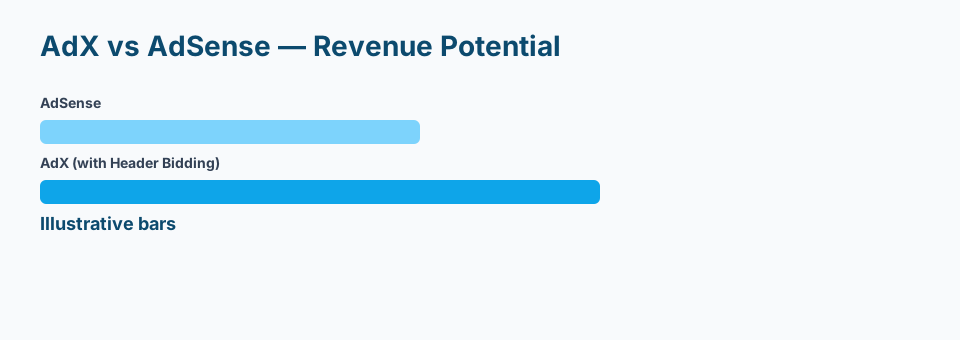
IMC Solution: We leverage advanced Header Bidding technology. This forces the world's top ad networks to compete in a real-time auction for your ad space before AdSense even gets a chance. This fierce competition drives up prices dramatically. The result? Our publishers frequently see a 50% to 250% increase in RPM compared to what they earned with AdSense alone.
- Problem: Slow Site Speed.
IMC Solution: Our proprietary ad-loading technology is built with Core Web Vitals as a top priority. We utilize lazy loading (ads only load when they're about to be seen), server-side optimizations, and a lightweight code base to ensure ads have a minimal impact on your site's performance. With IMC, a fast site and high revenue are not mutually exclusive; they are a package deal.
- Problem: Lack of Control & Poor Ad Quality.
IMC Solution: You get a dedicated ad strategist. This is your personal consultant. We work with you to block unwanted ad categories, optimize placements for both revenue and user experience, and ensure every ad complements your brand, not detracts from it. You are always in the driver's seat.
- Problem: No Support.
IMC Solution: Forget support forums and boilerplate email responses. With IMC, you have a direct line to your account manager—a real person who actively monitors and optimizes your ad performance, answers your questions, and provides proactive strategic advice. We are an extension of your team.
---
Mini Case Study:
Lifestyle blog "The Modern Patch" was stuck at an $8 RPM with AdSense, despite having over 150,000 monthly sessions. After switching to IMC, their RPM jumped to $27 within the first 45 days—a 237% increase. More importantly, their page load times improved by 1.2 seconds because of our optimized ad-serving technology.
---
*Ready to See What Your Website is Really Worth?*
Stop settling for AdSense scraps. The revenue you're earning now is likely just a fraction of your site's true potential. Get a free, no-obligation revenue projection from the IMC team and discover what you could be earning with a true ad management partner.
[Get My Free Estimate]
FAQ: Answering Your Top AdSense Questions
Let's tackle some of the most common questions publishers have about AdSense.
Is AdSense still profitable in 2024?
Yes, it can be. For very small blogs just starting out, or as a supplementary ad network within a larger, managed setup, it still has a place. However, it is rarely the most profitable primary option for serious publishers with established traffic.
How many pageviews do you need for AdSense?
There is no official minimum traffic requirement to apply, but realistically, AdSense isn't worth the effort (or the site speed hit) until you have at least a few thousand monthly pageviews. Premium managed networks like IMC require 250,000+ monthly pageviews to ensure their advanced technology can deliver significant revenue lifts.
What is a good RPM for AdSense?
This varies wildly by niche, but a general benchmark for a "good" AdSense RPM in an English-speaking market is anything over $10. Many sites operate in the $3-$8 range. In contrast, publishers using a managed ad partner like IMC typically see RPMs of $40-$50, driven by advanced data-driven optimization and a 90/10 revenue share.
Can AdSense get you rich?
It is extremely unlikely. The publishers who earn six or seven figures in ad revenue are not using a basic AdSense setup. They are using advanced technology like header bidding, sophisticated ad placement strategies, and have a dedicated team optimizing their ad stack—exactly the service that companies like IMC provide.
Conclusion: The Verdict on AdSense
So, is AdSense worth it?
Here’s the final verdict: AdSense is a valuable starting line, not the finish line.
It is an excellent tool for learning the basics of monetization. It gives new publishers a taste of what's possible and provides a simple, reliable way to generate their first few dollars online. For that, it deserves respect.
But for publishers who are serious about turning their passion into a profession, or their website into a business, AdSense is a glass ceiling. You will eventually hit a point where the low RPMs, slow site speed, and lack of support are actively holding back your growth.
Graduating from AdSense to a dedicated ad management partner is not a luxury; it's a necessary step in maximizing your site's value. It's the difference between earning a little pocket money and building a truly profitable digital asset.
If you're ready to cross that finish line and unlock your website's true earning potential, we invite you to see how the team at IMC can transform your ad revenue.